Modernize government communications for public service and critical operations
Avaya helps government and public-sector organizations connect citizen service, employee support, and critical operations through secure communications designed for complex environments. Modernize contact centers, unified communications, AI-enabled workflows, and mission-critical voice across cloud, hybrid, and on-premises deployments while maintaining control over continuity, security, and existing investments.

Proven scale for secure government communications
Supporting public service across cloud, hybrid, and on-premises environments, with FedRAMP Certified, Class C (Moderate), Rev. 5 offering and Department of War Impact Level 4 High provisional authorization.
80 +
agencies
4,000 +
sites
7.4M +
UC seats
350 K
contact center seats
Journeys DC — When communications can’t fail
Public sector leaders don’t talk about modernization in theory. At Journeys DC, they shared what it looks like when communications systems are tested in real-world moments.
From law enforcement operations to school safety, the conversation focused on mission-critical voice, security, and the infrastructure agencies depend on when it matters most.

Connect every interaction to the work that comes next
Public service often spans contact centers, agency programs, case-management systems, field offices, and back-office teams. When channels and workflows remain disconnected, people repeat information, employees search across systems, and follow-up becomes harder to track.
Avaya helps public-sector organizations connect voice and digital interactions with enterprise data, AI, and workflows. Agencies can preserve context, guide employees during complex interactions, route work to the right team, and coordinate the next step across systems while maintaining governance and human oversight.

Connect service across channels
Give residents and employees more consistent access across voice, messaging, digital self-service, and assisted service. Context can remain attached as an interaction moves between channels or teams, reducing unnecessary repetition.

Coordinate work across the agency
Connect front-office interactions with case systems, scheduling, documentation, approvals, and back-office workflows. Tasks can be routed and tracked so the interaction moves toward completion instead of ending with another handoff.

Apply AI with governance
Use AI to support self-service, employee guidance, routing, summarization, and workflow execution within defined permissions and data-access policies. Human employees remain available for sensitive, complex, or high-consequence situations.

Turn service data into action
Bring interaction and operational data together to help supervisors understand demand, identify workflow delays, improve employee support, and make service decisions using more complete context.
Start with the communications priority your mission requires
Public-sector communications modernization rarely begins and ends with one platform decision. An organization may need to secure a cloud environment, improve citizen service, strengthen critical voice, or evolve an established unified communications estate.
Avaya supports these priorities across cloud, hybrid, and on-premises environments. Agencies can begin with the capability that addresses the most immediate mission need and connect additional solutions as operational and security requirements evolve.
Access contract vehicles
Eligible government organizations can procure Avaya solutions through the Avaya Federal General Services Administration Schedule (Contract #GS-35F-0156V) and available state and cooperative contract vehicles. Avaya supports cloud adoption through authorized procurement paths, including GSA Multiple Award Schedule and prime-led vehicles such as 2GIT BPA, DLA/ITES, NASA SEWP V/VI, and GSA Enterprise Infrastructure Solutions.
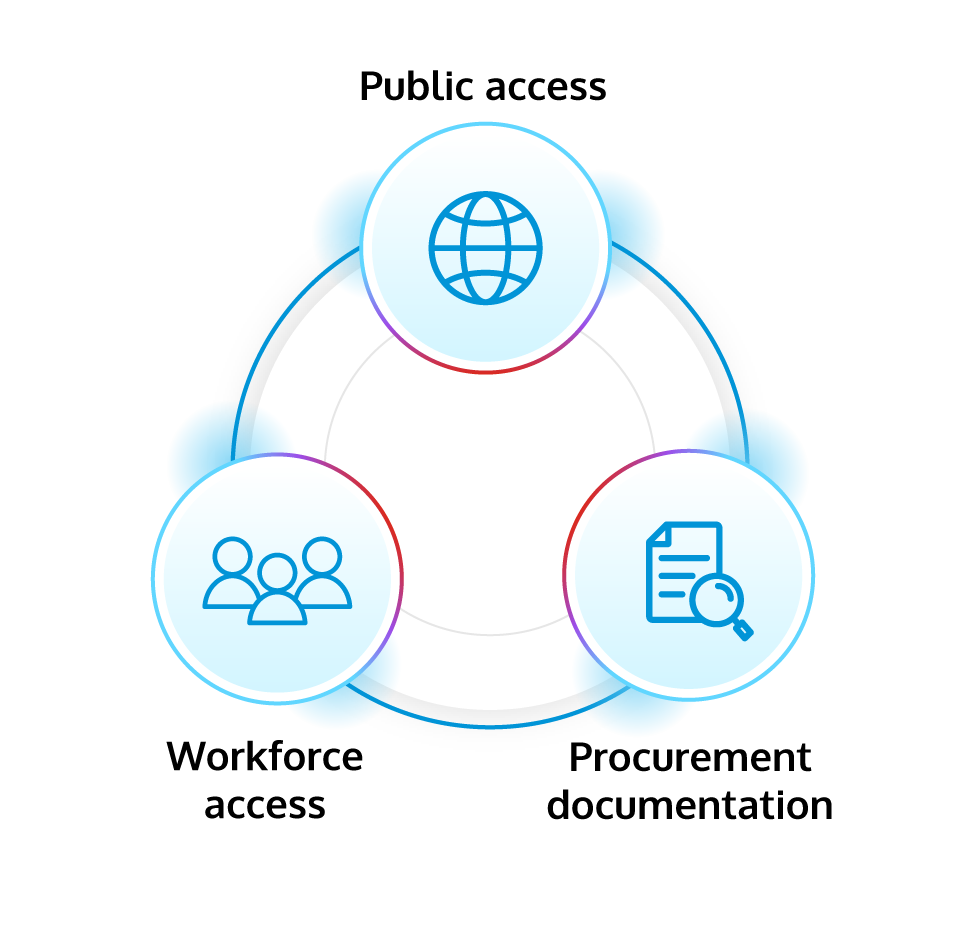
Support equitable access for the public and the workforce
Government communications must support people with disabilities across public-facing services, employee tools, contact centers, endpoints, and administrative environments. Avaya has adopted the requirements from Section 508 of the Rehabilitation Act, the European Accessibility Act (EAA), and the Accessible Canada Act (ACA).
Avaya publishes product-specific accessibility documentation and conformance information to help agencies evaluate communications technology during procurement, implementation, and modernization. These resources address applicable accessibility requirements and explain how individual Avaya products support different forms of access.
Evaluate product accessibility
Avaya conducts routine accessibility testing on all products. View our Product Accessibility Conformance Reports to see how our hardware and software comply with global standards.
Support different forms of access
Depending on the product, Avaya accessibility documentation may address areas such as screen-reader compatibility, visual display and contrast options, keyboard navigation, endpoint controls, and Telecommunications Relay Services.
Plan across the service environment
Use accessibility resources to evaluate agent tools, messaging, administrative interfaces, communication workflows, endpoints, and customer-facing service experiences for employees and members of the public.
Our contributions to accessibility policy
Avaya has contributed to U.S. telecommunications accessibility policy as an invited, voting member of the U.S. Access Board Telecommunications and Electronic and Information Technology Advisory Committee, which developed recommendations related to Sections 255 and 508, and the Federal Communications Commission Emergency Access Advisory Committee.
See how public-sector organizations are modernizing service and critical operations
Explore perspectives and customer stories from government environments where communications support public access, distributed operations, emergency response, and services that must remain available through change.
Government communications modernization FAQs
What is government communications infrastructure?
Government communications infrastructure is the connected foundation agencies use to serve the public and maintain essential operations. It can include enterprise voice, contact centers, digital service channels, collaboration tools, endpoints, emergency communications, operational systems, workflows, and security and governance controls.
The right architecture depends on the mission, operating environment, information involved, and continuity requirements. It may combine cloud, hybrid, and on-premises components rather than applying one deployment model across the entire organization.
How can agencies modernize government communications without replacing every existing system at once?
Agencies can modernize in phases by first identifying which systems, sites, endpoints, integrations, and emergency capabilities must remain operational. They can then prioritize workloads where cloud services, digital channels, AI, analytics, or modern voice capabilities can deliver the clearest value.
A phased plan allows compatible infrastructure to remain in service while new capabilities are introduced. Security, continuity, procurement, support, and funding should be planned together so each stage leaves the agency with a complete, supportable operating environment. Avaya’s public-sector materials similarly frame modernization around the technical blueprint, contracting approach, and financial plan.
How can government contact center solutions connect citizen interactions with agency workflows?
Government contact center solutions can connect an interaction to the work required to resolve the request. A call or digital message may need to initiate case review, scheduling, documentation, eligibility processing, an approval, or follow-up by another team.
Avaya Infinity connects interactions with enterprise data, AI, and workflows so agencies can preserve context, guide employees, route tasks, and coordinate action across systems. Service can continue beyond the initial interaction, with greater visibility into what needs to happen next. Avaya describes Infinity as an orchestration layer where customer interactions, enterprise data, AI, and employee workflows operate together in real time.
How can public-sector organizations use AI while maintaining governance and human oversight?
Public-sector AI should operate within agency-defined policies for data access, permissions, auditability, escalation, and human review. Agencies need to determine what an AI application may access, which actions it may perform, where approval is required, and when an interaction must move to an employee.
Avaya Infinity supports this approach by connecting approved AI, enterprise data, and workflows within an environment the organization controls. Its governance model is built around enterprise-defined policies, permissions, auditability, and control over deployment, data, and AI choices.
Can agencies move communications to the cloud while keeping existing phones, gateways, and collaboration tools?
Yes. A cloud transition does not necessarily require every endpoint, gateway, application, or location to move at the same time. A hybrid architecture can allow agencies to introduce cloud services while continuing to operate compatible on-premises infrastructure and collaboration tools.
The transition plan should account for emergency calling, security controls, integration dependencies, support responsibilities, and equipment lifecycles.
What communications capabilities support public safety, emergency response, and secure operations?
High-stakes environments require resilient voice, redundancy and failover, emergency communications, and connections with the operational systems teams use to coordinate action. Depending on the environment, those systems may include alerts, notifications, paging, radio, collaboration tools, and response workflows.
Avaya Nexus provides critical communications infrastructure for regulated and high-security environments where voice supports life-safety, emergency response, and operational continuity. It is designed to integrate with notification, workflow, radio, and broader collaboration ecosystems while maintaining the deployment and governance controls these environments require.
What should agencies evaluate when choosing a government communications solution?
Agencies should evaluate a solution against their mission, service environment, security requirements, and need for operational continuity. The evaluation should address deployment options, compatibility with existing systems and endpoints, emergency communications, accessibility, AI and data governance, interoperability, support and escalation responsibilities, and the precise authorization scope of any cloud service.
Procurement planning should also establish which contract vehicles are available, who owns each stage of the transition, and how cloud and existing services will be handled during migration.
Build a government communications modernization path around your mission
Talk with a public sector expert