| Launch mobility-service changes faster Give authorized teams visual tools to update ownership and mobility service. CHALLENGE Roadside and ownership-service workflow changes depend on specialist IT capacity. WITH AVAYA INFINITY Create and adjust approved workflows while IT retains governance and release control. | Recognize the traveler and itinerary context Use current context to make ownership and mobility service more relevant. CHALLENGE Static routing misses changes in the customer’s situation. WITH AVAYA INFINITY Use fleet, booking, and route context to inform routing, guidance, and next-best actions. | Adopt AI without locking yourself in Connect AI and enterprise context without fixing one provider forever. CHALLENGE New AI capabilities can require separate integration projects. WITH AVAYA INFINITY Orchestrate approved models and tools through an open enterprise architecture. |
AVAYA INFINITY® FOR TRANSPORTATION AND MOBILITY
Orchestrate every traveler journey from booking to destination
Avaya Infinity connects passenger interactions, fleet and transit data, AI, employees, operators, systems, and workflows to help transportation and mobility organizations turn every moment into coordinated action.
The transportation journey no longer begins or ends at the terminal
Passengers and shippers view your organization as a single entity, expecting seamless support for route planning, booking, ticketing, payments, schedule changes, delays, baggage, fleet status, loyalty, and general inquiries. However, required information and staff are often fragmented across CRM, reservation systems, transit management, ticketing, baggage tracking, fleet telemetry, scheduling, loyalty, and station operations. Avaya Infinity unifies passenger interactions, fleet and mobility data, AI, staff, operators, systems, and workflows in real time. This delivers connected travel journeys, faster resolution, increased operational effectiveness, and lasting customer loyalty.
Unified
Passenger interactions, transit systems, fleet telemetry, operators, employees, AI, and workflows operate in one orchestrated environment across digital channels, contact centers, stations, logistics hubs, and mobility services.
Contextual
AI and workflows use relevant passenger, booking, fleet, route, interaction, and journey context, not isolated signals, to support inbound and outbound engagement.
Real-time
Understanding, decisions, and authorized actions can happen during the interaction, helping employees and AI move the travel journey forward while the passenger is still engaged.
Governed
AI, passenger data, fleet data, and workflows operate within organization-defined policies, permissions, security controls, and auditability.
Controlled
Maintain control over deployment, passenger and transit data, AI choices, integrations, and the pace of modernization.
Mobility experience on their terms
Discover how to create connected experiences from showroom to road by bringing together customer interactions, vehicle data, AI, employees, dealers, and workflows.
HOW AVAYA INFINITY WORKS
Capture the power of intelligent orchestration for transportation and mobility
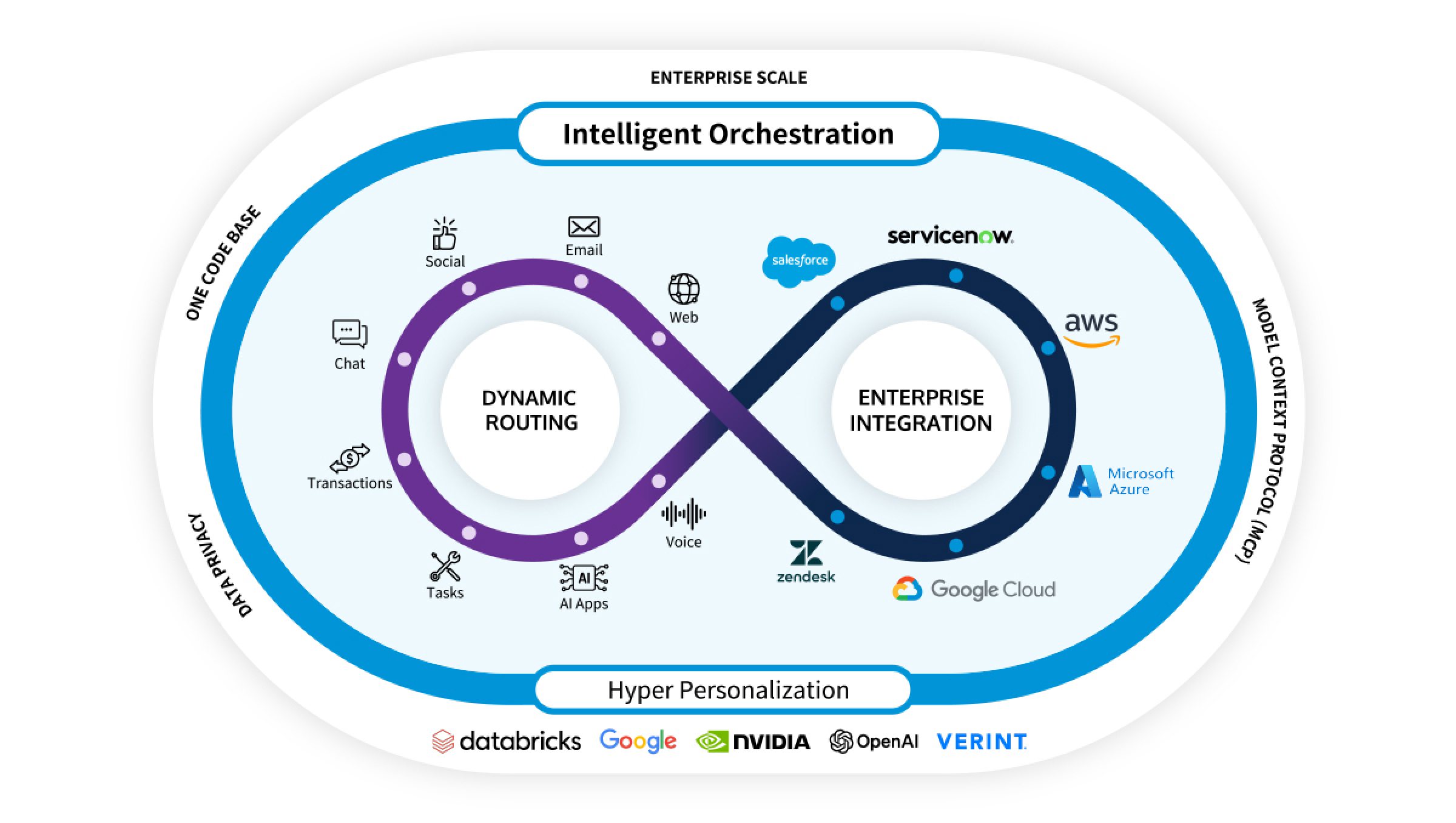
Avaya Infinity, with support for Model Context Protocol (MCP), connects passenger data, transit systems, fleet intelligence, AI, employees, operators, and workflows to deliver contextual, continuous travel journeys.

Get the advantages of cloud while maintaining the control complex transportation environments require
Modernize through a flexible architecture while maintaining options for cloud, hybrid, and on-premises workloads, passenger and fleet data, existing infrastructure, security, resilience, and operational requirements.

Infuse omnichannel transportation conversations with AI-driven workflows
Connect voice and digital interactions with workflow and task automation across reservations, passenger service, disruption rebooking, claims, alerts, billing, payments, connected fleet support, subscriptions, and other mobility journeys.

Hyper-personalize customer and employee experiences
Turn fragmented interaction, fleet, ticket, service, itinerary, and account data into actionable context that helps employees and AI understand who the traveler is, what trip they are taking, what has already happened, and what should happen next.

Connect and orchestrate without heavy-lift integrations
Connect existing transportation systems and emerging technologies through open integration, orchestration, MCP, and low-code/no-code workflows without requiring the organization to rebuild its technology environment around a new platform.

Rapidly adapt with AI-agnostic orchestration
Use AI models that fit your transportation strategy, balance experience, performance, and cost, apply enterprise guardrails, and evolve as AI, connected fleet, mobility, and autonomous transit technologies change.
Avaya Infinity AI-Powered Outbound Customer Engagement: From Dialing to Orchestration
Read the blogExplore Avaya Infinity by your role and business outcome
Choose your perspective to see how Avaya Infinity can support ownership and mobility service, day-to-day operations, and the technology priorities behind them.
- Business leadership
- CX operations
- IT leadership
| Connect customer care and service networks Move mobility-service requests toward completed follow-up. CHALLENGE Disruption response, station teams, and claims teams rely on manual handoffs. WITH AVAYA INFINITY Trigger and track authorized work across connected authorized transit, station, and claims systems. | Keep context across channels Carry relevant history across interactions with passengers and shippers. CHALLENGE People repeat itinerary details and earlier assistance requests after transfers. WITH AVAYA INFINITY Preserve authorized context so authorized operations and service teams can continue the journey. | Act on ownership-service friction sooner Support supervisors during weather-related travel disruptions. CHALLENGE Historical reports reveal service problems after they happen. WITH AVAYA INFINITY Use real-time analytics and AI-assisted insights to inform coaching and operational decisions. |
| Modernize with greater control Introduce CX capabilities while managing cost and operational risk. CHALLENGE Existing operator integrations and transit routing logic complicate change. WITH AVAYA INFINITY Phase modernization around route priorities, operator readiness, and release cycles. | Reduce routine IT dependency Delegate suitable service-intake and routing updates to authorized users. CHALLENGE Routine changes consume specialist development capacity. WITH AVAYA INFINITY Use governed visual tools while IT controls access, architecture, and release policies. | Keep your AI strategy flexible Connect AI and data without centering the architecture on one model. CHALLENGE New tools can add integration complexity and vendor dependencies. WITH AVAYA INFINITY Use open orchestration for approved AI, authorized transit, station, and claims systems, and workflows. |
Why transportation and mobility organizations choose Avaya
Avaya is trusted across the transportation and mobility ecosystem, from global transit authorities and airlines to fleet operators and passenger transport providers.
- CAA Club Group, part of the Canadian Automobile Association, has been publicly identified by Avaya as a customer
- Avaya transportation solutions span hub operations, schedule management, disruption workflows, secure payments, passenger care, and journey orchestration
Complete passenger and fleet understanding
Bring together authorized interaction history, fleet and itinerary information, booking context, connected services, claims, travel history, intent, and other transit data to create a more complete real-time understanding of the passenger.
Intelligence that explains and improves
Understand not only what happened during an interaction, but why, helping transportation leaders identify journey friction, improve service, strengthen partner relationships, reduce avoidable contacts, and continuously improve the travel experience.
Bring your own, keep what works
Bring your own carrier, messaging, workforce management (WFM), and AI, and integrate preferred workforce engagement management (WEM) tools. Transportation and mobility organizations can preserve selected provider relationships, agreements, and technology investments while modernizing passenger and mobility service.
Open, enterprise-ready architecture
Use MCP and open integration to connect AI, transit systems, passenger data, fleet intelligence, operator systems, and workflows without depending exclusively on brittle point-to-point integrations or a single technology provider.
Enterprise control and governance
Maintain control over architecture, passenger data, fleet information, AI choices, system access, governance, and auditability as transportation experiences become more intelligent and connected.
Action in the moment
Help employees and AI guide decisions, automate authorized steps, and advance work across systems during the interaction, whether a traveler is booking a trip, reporting a disruption, checking a refund, responding to a schedule change, making a payment, or asking about a service feature.
Enterprise control, without the one-platform tradeoff
Transportation customer experience spans one of the most complex technology ecosystems of any industry. A global transportation organization may operate consumer booking sites, operator networks, connected fleet platforms, telemetry, freight businesses, disruption assistance operations, contact centers, mobile applications, claims systems, maintenance networks, station environments, and technology investments built over decades. The future adds even more complexity through electric transit, software-defined mobility, micro-mobility services, transport subscriptions, physical AI, and increasingly autonomous systems.
Avaya Infinity is designed for that transportation reality:
- Flexible deployment: Cloud, hybrid, on-premises, and backward-compatible modernization paths
- Open AI architecture: Orchestrate multiple AI models and specialized technologies without committing every customer journey to one provider
- Connected fleet context: Bring appropriate fleet, service, passenger, and interaction information into travel workflows
- Governed operations: Role-based access control (RBAC), audit trails, retention controls, and bring your own key (BYOK), aligned to the selected deployment and organizational policies.
- Enterprise resilience at scale: Geo-redundancy, API gateway support, health dashboards, and hyperscaler infrastructure to support resilience, geographic reach, and scale within the chosen deployment design.
- Extensible ecosystem: Connect CRM, operator, ticketing, telemetry, service, AI, data, workforce, payment, and other technologies
LOWER TCO BY DESIGN
Get more from the investments you already have
Add new AI, data, and orchestration capabilities for ownership and mobility service without requiring wholesale replacement of the technology, provider agreements, and infrastructure already supporting your organization.
Build on what you have
Extend your existing Avaya environment and modernize passenger assistance, schedule updates, and rebooking in phases.
Keep valuable investments
Retain selected carrier agreements, messaging services, WEM/WFM platforms, and other technologies where they continue to make sense.
Invest where it creates value
Prioritize new capabilities around brand priorities, service-network readiness, and release cycles.
PATH TO MODERNIZATION
A flexible path forward for Avaya CC Elite transportation customers
Your Avaya CC Elite environment already supports critical travel journeys with tailored routing, integrations, and business rules. Modernization doesn't require total replacement.Avaya Infinity lets you add real-time AI, digital engagement, data, and automation on top of your trusted foundation.
Extend existing investments
Build on your current Avaya environment and transportation systems while introducing new AI, automation, analytics, digital engagement, and orchestration capabilities. Introduce new customer experience capabilities while preserving the communications, integrations, business logic, and operational processes already supporting passengers and operators.
Move in phases
Modernize specific brands, regions, terminals, mobility services, customer journeys, or capabilities according to business priorities, technology roadmaps, seasonal schedules, and operational readiness.
Accelerate workflow migration with AI
Use AI-assisted analysis, workflow generation, and validation to carry proven intake, rebooking, and claims routing logic toward Infinity. Your teams and Avaya experts retain control of testing and rollout.
Keep deployment control
Support cloud, hybrid, and on-premises requirements rather than forcing every transportation workload into the same architecture.
"We've been able to build a sense of trust with Avaya and then also with the users that I am supporting."
Alex Williams Deputy CIO/CTO, New York City Public Schools
See Avaya Infinity in action. Choose your demo:
- Product Tour
- Live demo series
- Custom demo
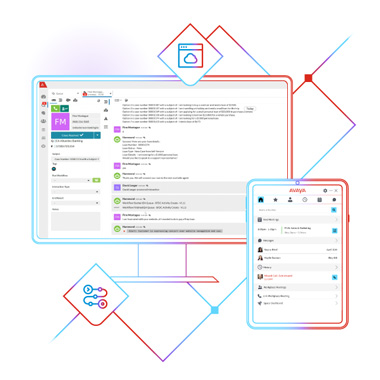
Take a self-guided tour
Experience Avaya Infinity from the perspective of a traveler, transit employee, and administrator. Explore connected voice and digital journeys, contextual service, AI-enabled assistance, intelligent orchestration, and low-code/no-code workflows at your own pace.
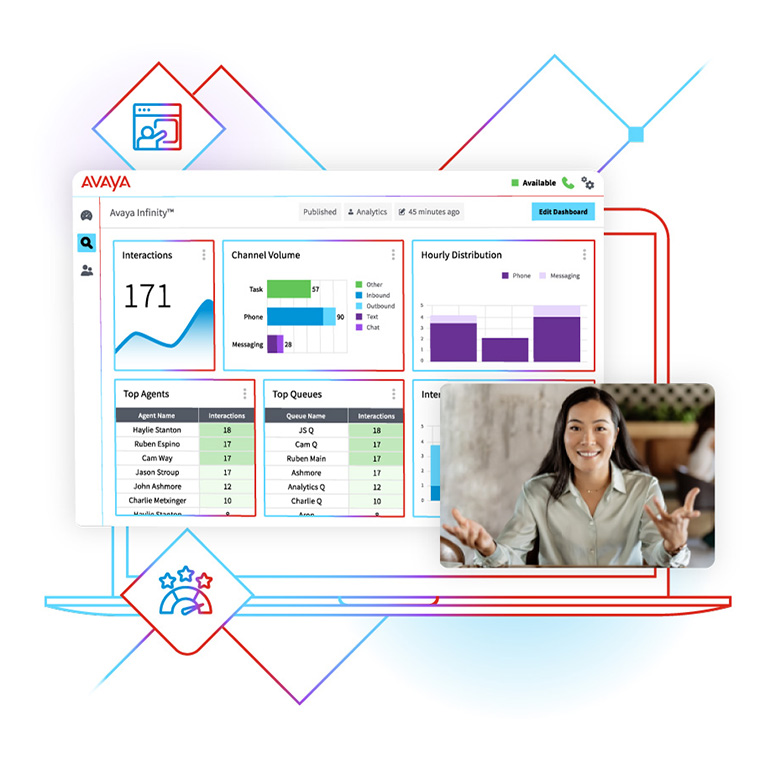
Register for our live demos
Explore the next generation of enterprise customer experience and see how Avaya Infinity can help transportation and mobility organizations introduce AI, orchestration, connected data, and digital capabilities while building on existing customer experience investments.
Request a personalized demo
See Avaya Infinity applied to the journeys that matter most to your customers and your business. An Avaya specialist can tailor the experience around ticket sales, station support, disruption assistance, schedule updates, connected fleets, claims, delays, EV transit, proactive engagement, or other transportation and mobility workflows.

An open ecosystem for connected mobility
Your organization already depends on critical platforms for CRM, reservation management, connected fleets, telemetry, billing, disruption management, schedule planning, baggage, payments, passenger data, workforce management, analytics, and customer engagement. Those technologies will continue changing as transit networks become increasingly software-defined, connected, electrified, and automated.
Avaya Infinity is designed to connect with that reality.
Infinity brings together AI models, authorized passenger and fleet data, Avaya capabilities, and partner technologies in an open ecosystem designed for real-time orchestration. With MCP and open integration, transportation organizations can activate appropriate context across passenger journeys and evolve their AI strategy without having to standardize every station, fleet platform, business unit, and customer workflow around a single technology provider.
Examples across the Avaya Infinity ecosystem
- CRM and agent experience: Salesforce, Microsoft Dynamics 365, ServiceNow, Zendesk, and Microsoft Teams.
- Workforce engagement: Verint WEM, with flexibility to integrate preferred WEM and WFM environments.
- Telecom and messaging: Bring-your-own carrier and messaging options to preserve existing provider relationships and commercial arrangements.
MODEL CONTEXT PROTOCOL
The power of context across the traveler journey
Transportation CX depends on context. Customer service advisors, disruption teams, connected transit users, and delay notification teams require connected passenger, fleet, and hub data. Beyond basic Q&A, AI agents need enterprise systems, APIs, and tools. MCP provides an open model for AI to convert passenger and transit data into coordinated action.
AI-powered context unlocked by MCP delivers personalization at scale
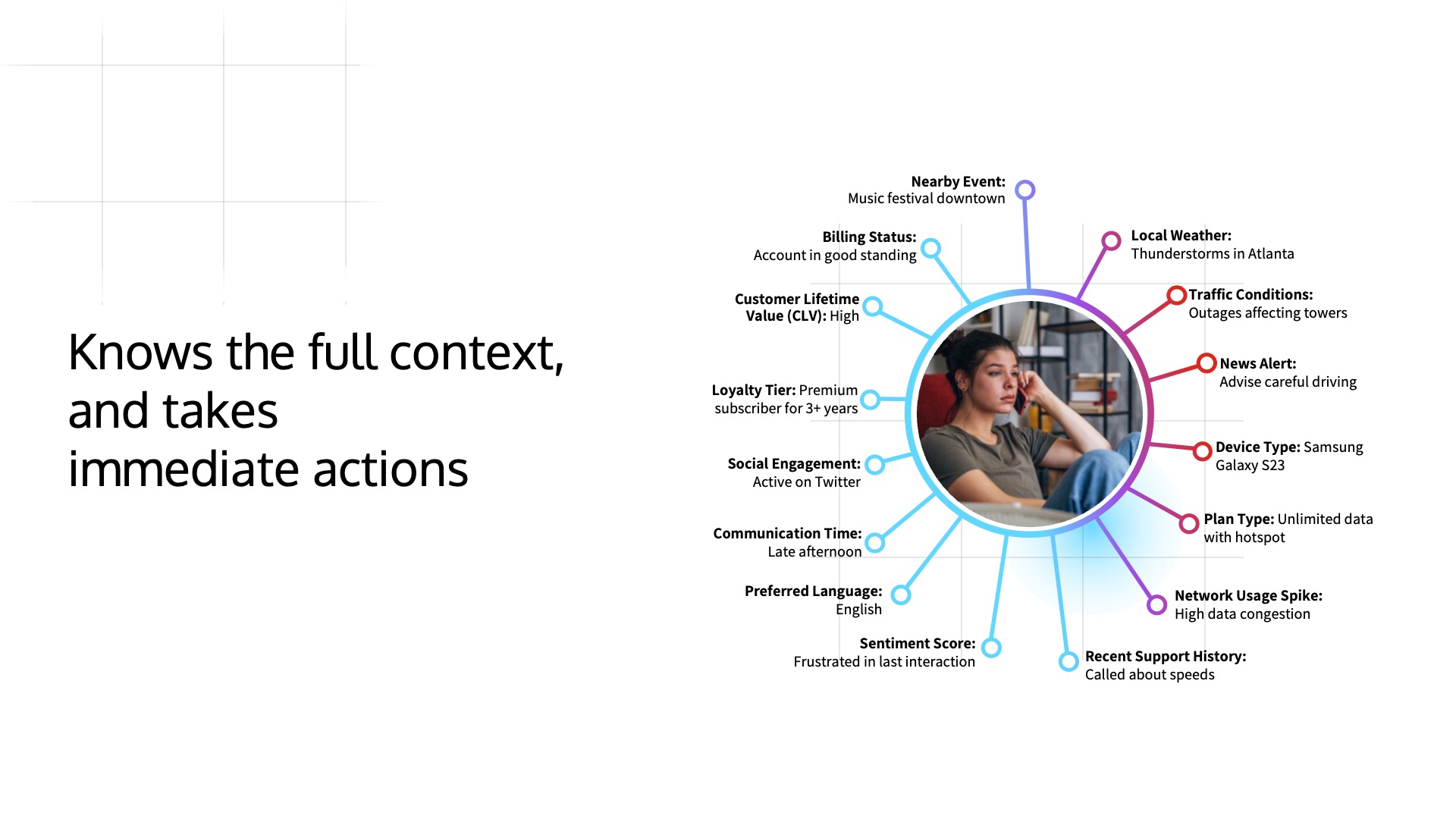

The action-ready AI agent built with MCP
Avaya Infinity combines agentic AI and Model Context Protocol to unify passenger, fleet, station, enterprise, and workflow context for transportation organizations.AI advances beyond simple Q&A to execute real-time actions under organizational governance, security, and human oversight.

Moments that keep customers moving
Avaya Infinity is built for the moments that define the transportation relationship, when passenger context, fleet intelligence, AI, employees, operators, transit networks, and enterprise systems need to work together.

Do we already know the traveler and their itinerary?
Bring together authorized passenger, booking, journey, interaction, service, claim, and connected-fleet context to create a more complete understanding before and during the interaction.

Does the passenger have to explain the issue again?
Carry appropriate context across web, mobile, transit experiences, virtual agents, IVR, agentic AI, contact center employees, stations, operational teams, and technical experts so the journey can continue rather than restart.

Can the fleet notify us of delays before the traveler calls?
Where authorized connected fleet data and integrations are available, use relevant vehicle, vessel, or flight events and operational context to help AI and employees better understand the situation and trigger appropriate workflows.

Can we reach the traveler before a delay becomes a major disruption?
Use authorized schedule, delay, connection, subscription, and passenger events to trigger timely communications and appropriate next steps.

Should AI handle this or should a transit specialist step in?
Coordinate AI and human expertise based on complexity, safety, urgency, traveler needs, transit context, and the moments where operational judgment, empathy, or specialized knowledge matters most.

Can we get help to a stranded traveler without making them navigate the organization?
Orchestrate authorized loyalty, passenger, location, itinerary, operator provider, dispatch, notification, and employee workflows so assistance can move forward while the passenger is still engaged.

Can we connect a travel disruption to alternative connections?
Carry appropriate context from disruption management into rebooking or ground transport workflows so the next resource understands what happened, what assistance was provided, and what the traveler may need.

Can our AI strategy evolve as mobility becomes more intelligent?
Support multiple AI models, open standards, partner technologies, APIs, and flexible orchestration so passenger experience can evolve alongside connected, software-defined, electric, and increasingly autonomous transit systems.
Frequently asked questions about Avaya Infinity for transportation and mobility
How is Avaya Infinity different from traditional CCaaS for transportation companies?
Traditional CCaaS platforms may require transportation organizations to move complex passenger operations into a standardized cloud architecture.
Avaya Infinity takes a different approach by connecting interactions, AI, passenger and fleet data, existing transit systems, employees, operators, and workflows through a real-time orchestration layer.
That gives transportation companies a way to modernize customer experience while building on existing operator systems, connected fleet platforms, CRM, Avaya infrastructure, billing systems, service applications, integrations, and technology investments.
What enterprise CX leaders are really asking in AI platform demos
How does Avaya Infinity scale for large ownership and mobility service contact centers?
Avaya Infinity is designed for complex contact centers with thousands of agents. Cloud, hybrid, and on-premises options combine with geo-redundancy, API gateway support, health monitoring, and hyperscaler infrastructure. Capacity and deployment design are tailored to the environment’s requirements rather than treated as a single fixed configuration.
For transportation and mobility organizations, deployment planning can account for weather-related travel disruptions, distributed teams, and existing service commitments.
Why is orchestration particularly important in transportation?
Transportation customer journeys cross many systems and organizations. A single service issue might involve the passenger, fleet operator, transit authority, ground transport provider, claims system, inventory, billing relationship, and station resources.
Answering the traveler's question is only one part of the experience. Orchestration connects the systems, data, employees, AI, and actions required to help deliver the actual customer outcome.
Why does MCP matter for transportation and mobility?
Model Context Protocol provides a standardized way for AI to connect with enterprise systems, data, tools, and APIs.
For transportation organizations, MCP can help AI work with appropriate context from CRM, connected fleet systems, station applications, claims, billing, disruption management, schedule planning, knowledge, and other authorized sources instead of operating as a disconnected assistant.
An open protocol also gives transportation companies greater flexibility to evolve AI technologies without creating proprietary integrations for every model, fleet platform, and enterprise application.
What is tandem care, and why does it matter in automotive?
Tandem care combines AI and human employees into a coordinated operating model. AI can gather information, summarize itinerary history, search knowledge, assist with routine rebooking, provide status information, and coordinate workflows. Transportation professionals can focus on complex travel disruptions, stranded passengers, high-value bookings, safety-sensitive situations, service recovery, and moments requiring expertise or empathy.
The objective is not to remove people from the ownership journey. It is to make human expertise more effective when the customer needs it most.
How can Avaya Infinity improve disruption assistance?
Travel disruption management is one of the clearest examples of why context and orchestration matter. A stranded traveler may need booking verification, location confirmation, itinerary details, delay status, alternative connections, dispatch, arrival updates, and follow-up.
Infinity can connect the customer interaction with authorized systems, AI, employees, and workflows so the experience can move from "I need help" toward coordinated action.
Can AI help determine what kind of disruption support is needed?
AI can help gather information from the customer, interpret the situation, access authorized knowledge and customer context, and help classify the type of assistance required.
Where integrations and policies permit, other fleet or schedule context could also contribute to the workflow.
Safety-sensitive situations or uncertain cases can be routed to appropriate human employees.
How can Avaya Infinity improve operator customer experience?
The front-line operator remains one of the most important human touchpoints in transportation.
Infinity can help connect digital and contact center journeys with operator workflows so relevant context can move with the traveler.
A customer who researches a route, schedules a trip, asks a ticketing question, books service, or reports a delay should not have to recreate the journey each time they reach another part of the organization.
How can Avaya Infinity support rebooking and scheduling?
A rebooking or schedule change may depend on passenger preferences, itinerary details, station location, seat or capacity availability, ticket rules, connections, previous trip activity, and the reason for the change.
Infinity can orchestrate appropriate data and workflows across connected systems to help AI and employees identify options and advance authorized scheduling processes during the interaction.
Can Avaya Infinity use connected fleet data?
Where integrations, traveler permissions, data policies, and applicable requirements permit, connected fleet information can provide useful context during passenger interactions.
This might include relevant schedule events, route information, software context, or telemetry signals.
Infinity can help make appropriate data available to AI and employees when the travel journey requires it rather than creating another disconnected transit-data silo.
How can Avaya Infinity support proactive travel alerts?
Customer service does not always have to begin when the passenger calls. Authorized schedule, delay, disruption, connection, or other events can trigger workflows that notify passengers, provide relevant information, recommend appropriate next steps, or help rebook travel. This can help transportation organizations move from reactive support toward proactive traveler care.
How can Avaya support service disruption notifications?
Avaya provides proactive customer care capabilities that include automated service disruption notifications and response tracking.
Transport providers can connect authorized schedule and passenger information with outbound engagement and workflows to help identify affected travelers, communicate appropriate information, track response, and escalate situations requiring additional support.
This turns disruption communication into a coordinated customer journey rather than an isolated alert.
How can Avaya Infinity improve travel claim experiences?
Claim interactions can cross passenger information, booking identification, itinerary, delay history, entitlement, refunds, operator systems, approvals, and rebooking.
Infinity can help orchestrate those systems and workflows so AI and employees have appropriate context and can move the process forward without requiring the customer to navigate the organization.
How can Avaya Infinity support transport billing journeys?
Transportation relationships may also include ticketing, passes, payments, account service, subscription updates, and route changes.
Infinity can connect authorized billing and passenger context with voice, digital engagement, AI, employees, and workflows to create more continuous experiences.
Financial information and transactions remain subject to the organization's security, regulatory, data, and access requirements.
How can Avaya support secure payments?
Avaya can orchestrate specialized payment technologies as part of the customer journey. This can allow a customer to move from conversation or AI assistance into an appropriate secure payment process and then continue the interaction afterward without unnecessarily restarting the experience. Specific payment capabilities and compliance requirements depend on the service and technologies being deployed.
How can Avaya Infinity support EV transit journeys?
Electric transit introduces additional customer experiences around charging infrastructure, range, software, fleet performance, schedule adjustments, and new operational behaviors.
Infinity can connect appropriate customer, vehicle, charging, knowledge, service, and enterprise context to help AI and employees better understand the customer's situation.
As EV technologies continue evolving, open orchestration can help automotive organizations add new systems and capabilities without rebuilding the entire customer experience.
How can Avaya Infinity support mobility subscription services?
Mobility relationships increasingly extend beyond a traditional vehicle purchase.
Subscriptions may involve vehicles, connected services, software features, charging, roadside support, insurance, maintenance, or other mobility services.
Infinity can connect interactions with authorized subscription, account, vehicle, payment, and service context to help organizations coordinate onboarding, support, renewal, upgrade, and cancellation journeys.
How can Avaya Infinity support software-defined transit?
As transit networks become more software-defined, passenger questions increasingly involve digital ticketing, app features, subscriptions, updates, real-time tracking, and digital services.
Infinity can connect the customer interaction with appropriate vehicle, software, account, knowledge, and technical support context so AI and employees can provide more relevant assistance.
The passenger experience can therefore evolve along with the transit system rather than remaining centered only on traditional schedule inquiries.
How can Avaya Infinity help during a connected transit disruption?
A connected transit disruption can rapidly generate passenger questions across voice, digital channels, stations, and support organizations. Infinity can connect current incident context with self-service, AI, intelligent routing, proactive engagement, employee guidance, and workflows. This can help provide more consistent information and reduce unnecessary customer effort while the incident is being resolved.
How can Avaya support multilingual transportation operations?
Global transportation organizations serve passengers, operators, and employees across languages, countries, and regions. AI-powered multilingual capabilities can help reduce language barriers across customer interactions while intelligent routing can connect customers to specialized employees when necessary. This is particularly valuable for global disruption, connected fleet, premium support, and passenger care operations.
How can Avaya Infinity support loyalty and passenger retention?
The traveler relationship can last for years. Travel history, booking patterns, interaction history, connected services, loyalty status, and other authorized context can help organizations better understand the relationship as passengers plan future travel. Infinity can help orchestrate proactive engagement and appropriate employee involvement around moments that may influence retention and repeat bookings.
How can Avaya help transportation organizations increase revenue?
Customer experience can contribute directly to revenue through bookings, ancillary services, upgrades, subscriptions, loyalty programs, and repeat travel. Infinity can connect customer context with appropriate recommendations, proactive engagement, workflows, and human expertise to help identify opportunities while keeping the experience relevant to the customer's needs.
How does Avaya Infinity support AI governance?
Avaya Infinity is designed to give organizations control over AI model selection, enterprise data, fleet and passenger information, system and tool access, workflows, permissions, and execution.
Transportation organizations can define which AI models are allowed to access specific information and which actions those models may perform. This becomes increasingly important as transportation AI moves from answering questions to interacting with connected fleets and enterprise systems.
With support from technologies such as Databricks, teams can monitor how AI uses information, track performance, and maintain data oversight as adoption grows.
What deployment models are supported?
Avaya supports cloud, hybrid, and on-premises deployment approaches.
For transportation organizations, this provides flexibility to modernize different workloads according to architecture strategy, security requirements, passenger and fleet data policies, existing systems, station environments, operational dependencies, and business continuity requirements.
Modernization can happen in phases rather than through a single forced migration.
Why should Avaya CC Elite transportation customers consider Avaya Infinity?
Because modernization does not have to begin with replacement. CC Elite may already support high-volume traveler care, station, billing, disruption, and connected fleet operations with years of customized routing, integrations, workflows, and business logic.
Avaya Infinity provides a path to build on that foundation by adding real-time AI, digital engagement, connected passenger and fleet data, workflow automation, and cross-system orchestration. That allows transportation organizations to modernize the journeys that matter most while protecting the value of existing investments.
How does Avaya Infinity work with enterprise data platforms like Databricks?
Avaya Infinity uses the Databricks Data Intelligence Platform and unified Lakehouse to bring structured and unstructured contact center data into an AI-ready foundation with centralized governance and audit trails. Delta Sharing supports secure, zero-copy data sharing. Pre-built assets help business managers access insights, and automated AI Judges provide visibility into human and AI agent performance. Authorized enterprise data can inform interactions while access and oversight remain governed.
Can Avaya Infinity work with the carrier, messaging, WFM, and WEM investments we already have?
Yes. Avaya Infinity supports bring-your-own carrier, messaging, workforce management (WFM), and AI options, and can integrate preferred workforce engagement management (WEM) tools. This gives organizations a way to retain selected provider relationships, negotiated agreements, and technology investments while adding new capabilities.
Which CRM and collaboration environments can Avaya Infinity work with?
Avaya Infinity offers embedded agent experiences and integration options for Salesforce, Microsoft Dynamics 365, ServiceNow, Zendesk, and Microsoft Teams. Depending on the integration, employees can use capabilities such as call controls, screen pops, click-to-call, directories, and collaboration within familiar workspaces. Available functions depend on the selected integration.
What workforce engagement capabilities are available with Avaya Infinity?
Avaya works with Verint to provide workforce engagement capabilities and also supports integration with preferred WEM and WFM environments. Organizations can build on selected workforce tools already in use instead of treating their replacement as a prerequisite for CX modernization.
How is Avaya Infinity priced?
Avaya Infinity uses a flexible per-seat commercial model. Packages, licensing, add-ons, and services depend on organizational requirements. Named and Concurrent licensing options, volume ranges, contract terms, and bring-your-own choices provide additional flexibility. A proposal should reflect the required capabilities and deployment.
How can Avaya Infinity help lower total cost of ownership?
Avaya Infinity can help reduce avoidable replacement and migration costs by extending existing technology investments. Organizations can retain selected infrastructure, carrier agreements, messaging services, and workforce tools while introducing new capabilities in phases. The resulting cost profile depends on the environment and modernization scope.
Resources
Reimagine transportation and mobility experience with Avaya Infinity
Transform your transportation contact center into a mobility connection center
Request a demo