Rearchitecting transportation and mobility customer experience for the MCP generation
AI is transforming how transportation and mobility organizations serve passengers, support members and customers, coordinate services, and operate across increasingly complex technology environments. But one question stands above the rest: Who controls the future of your customer and employee experiences, your organization or your technology vendors?
At Avaya, we believe the answer should be you. That is why we are embracing the open future of AI, building the Avaya Infinity® platform to support Model Context Protocol (MCP).
It is the right move for transport operators, mobility providers, transit agencies, logistics and fleet operators, and other transportation businesses that need to innovate without abandoning trusted systems, sensitive passenger data, established workflows, or the security and governance requirements that keep people moving.
What is MCP?
MCP (Model Context Protocol) is an open standard allowing AI models like GPT, Claude, or Gemini to securely connect with external tools, APIs, data sources, and user context. For transportation and mobility providers, MCP gives AI the operational context—such as passenger details, fleet status, trips, service requests, or rebooking—to work within existing systems, workflows, and permissions. This enhances AI utility across customer care, disruption support, reservations, fleet management, and schedule planning.
"This is not a 'wait-and-see' moment. Avaya believes the time to be intentional about building the definitive open orchestration engine for the modern enterprise is now."
David Funck, Chief Technology Officer, Avaya
How does MCP work?
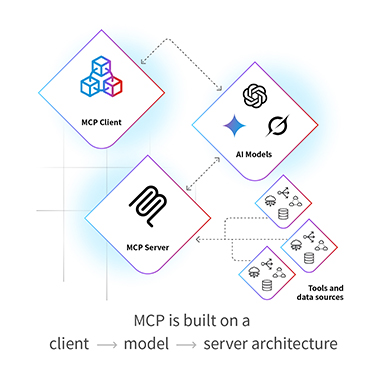
MCP is built on a client → model → server architecture:
- The Client gathers context such as passenger or employee information, itinerary details, role, current task, permissions, interaction history, location, or service environment.
- The Model such as Claude or GPT receives the context and a list of available tools or actions.
- The Server hosts approved tools, APIs, databases, and transportation or mobility systems and executes authorized actions requested by the model.
All communication follows structured schemas so interactions can be interpretable, traceable, and governed, an important requirement when AI is interacting with passenger information, fleet data, location context, service workflows, and time-sensitive mobility operations.
Avaya Infinity with MCP: Achieving AI-powered transportation and mobility communications intelligence
Learn how transportation and mobility organizations can analyze customer experience data to build real-time insights beyond standard dashboards. Authorized roles—such as CX leaders, supervisors, operational teams, fleet operators, and service personnel—can safely explore critical metrics while maintaining enterprise data access controls.

Removing friction from transportation and mobility AI with MCP
For too long, bringing AI into transportation and mobility customer experience has meant choosing between two difficult options:
- Lock in to a single provider's closed ecosystem, limiting flexibility as AI models, connected fleet technologies, customer expectations, service models, and mobility strategies evolve.
- Create costly, one-off integrations across CRM, telemetry, disruption assistance, transit systems, reservations, fleet management, operator systems, schedule planning, knowledge platforms, payments, and other applications.
This false choice slows innovation and places additional pressure on already complex transportation and mobility technology environments. It can also fragment the customer experience when information is distributed across fleet systems, mobile apps, contact centers, station networks, operators, service providers, and legacy and modern systems.
Enter MCP, an open, vendor-agnostic standard designed to help AI models interact with tools, data, and operational logic securely and at scale.
Think of MCP as a universal connection layer for AI. Instead of building a different connection between every model and every transportation or mobility system, organizations can create a standardized way for approved AI capabilities to access the context and tools they need.
As the AI ecosystem evolves, this approach can give transportation and mobility organizations greater freedom to innovate while maintaining control over the systems, data, workflows, partner networks, and customer relationships that differentiate their business.
MCP enables AI systems to operate with dynamic awareness of passenger, employee, fleet, session, location, trip, and service context.
For Avaya Infinity, this means AI models can deliver experiences informed by relevant information across complex transportation and mobility environments. A disruption assistance interaction could draw upon approved member, fleet, location, service history, dispatch, knowledge, and interaction data while respecting the permissions governing each source.
That level of contextual intelligence can be especially valuable for organizations managing millions of travelers and members, thousands of employees and service providers, large transit fleets, broad geographic coverage, complex partner ecosystems, and service interactions where every minute can matter.
Shaping the future of open AI for transportation and mobility customer experience
Avaya is not just talking about open AI. We are actively helping shape open standards while bringing native MCP support to Avaya Infinity for secure, model-agnostic, enterprise-ready orchestration.
For transportation and mobility organizations, that creates three important advantages:
- Control: Gain more control over AI models and tools so you can select capabilities based on the requirements of each passenger, fleet, disruption, or mobility use case instead of the limitations of a single vendor.
- Governance: Strengthen interoperability and oversight across customer experience systems, vehicle and mobility data, workflows, applications, and AI so capabilities can be introduced responsibly.
- Future-readiness: Build an AI architecture designed for fast-changing mobility environments where security, reliability, interoperability, scalability, and long-term flexibility are essential.

Collaboration with Databricks
As part of our commitment to secure, scalable, and open AI, Avaya is collaborating with Databricks to bring enterprise-grade governance and data privacy capabilities to the MCP implementation within the Avaya Infinity platform.
For transportation and mobility organizations, this approach can help establish controlled access between AI and the structured and unstructured data distributed across passenger, fleet, station, service, and enterprise systems.
With fine-grained access controls, audit logging, and governed integration with enterprise data sources, organizations can explore AI-powered customer and employee experiences while maintaining greater visibility into how information is accessed and used.
"Generative AI offers tremendous potential to transform customer experiences, and we are thrilled to collaborate with Avaya to help organizations quickly unify their data, simplify data and AI governance and security, and ultimately deliver AI that understands their business."
Heather Akuiyibo, VP of GTM Integration, Databricks

From fragmented transportation systems to freedom with MCP
A typical transportation or mobility organization may have dozens or hundreds of tools and data sources, including CRM, telemetry platforms, connected fleet systems, disruption management applications, reservations, fleet management, operator systems, schedule planning, knowledge bases, payment platforms, workforce applications, and analytics environments. At the same time, multiple AI models, copilots, applications, and agents may need controlled access to those systems.
Before MCP, connecting each system to each AI model could require its own point-to-point integration. As the number of systems and AI capabilities grows, so does the development effort, maintenance burden, complexity, and technical debt. MCP changes that paradigm by introducing a standardized intermediary layer. Instead of solving an increasingly complex N x M integration problem, transportation and mobility organizations can move toward a more scalable N + M model.
Each approved tool can expose capabilities through an MCP server, while AI models and applications connect through MCP clients. Once components can communicate through MCP, transportation and mobility organizations gain a more flexible foundation for connecting AI with existing and future systems. That can dramatically reduce redundant integration work while protecting investments already made in the technologies and workflows that support travelers, members, fleets, employees, and partners today.
This matters because transportation and mobility journeys rarely live in one application. A single interaction may touch communications, CRM, fleet data, telemetry, location services, dispatch, operator systems, schedule planning, reservations, payments, knowledge, and analytics. Avaya Infinity with MCP can help connect those technologies, insights, channels, and workflows so organizations can modernize the experience without requiring the entire technology environment to be replaced first.
The potential ROI of MCP for transportation and mobility
With MCP, Avaya Infinity users can unlock deeper business and operational value by giving AI access to more relevant context and approved enterprise capabilities.
For transportation and mobility organizations, that can mean faster disruption assistance, more informed passenger interactions, more efficient service coordination, better connected fleet support, greater employee productivity, and stronger continuity across the mobility journey.
MCP creates the foundation for generative and agentic AI that is not simply intelligent, but situationally aware of the passenger, fleet, location, trip, itinerary history, mobility need, and permissions surrounding an interaction.
| Before MCP | After MCP | |
| Integration | Custom connectors between individual AI models and transportation or mobility systems | A standardized MCP interface can work across models and approved enterprise tools |
| Deployment time | Longer implementation cycles driven by bespoke integration and engineering | 50–70% faster, lower costs via reuse (quiq.com, Palma AI, Humanloop, aibase.com) |
| Data access | AI operates with limited visibility into passenger, fleet, location, and service context | AI can access approved real-time context across CRM, telemetry, disruption management, fleet, service, and other systems |
| Risk management | Employees manually search multiple systems to understand the passenger, fleet, location, and available options | AI can help surface relevant passenger, fleet, dispatch, and service information earlier in the interaction or workflow |
The future of transportation and mobility AI is open
Transportation and mobility organizations have built valuable systems, data, and customer relationships over decades and should maintain control as they enter the AI era. Leading AI providers and Avaya share a vision focused on open, contextual solutions.
By introducing MCP to enterprise CX, Avaya enables organizations to connect AI with trusted systems, select optimal models, preserve architectural control, and continuously innovate. The future of mobility customer experience depends on intelligently connecting every traveler, fleet, service, and journey rather than using closed technology stacks.
Learn how Model Context Protocol reinforces Avaya’s open AI strategy
Glossary
Full glossary of terms below.
| Term | Definition | Why It Matters for Transportation and Mobility |
| MCP (Model Context Protocol) | An open protocol that standardizes how AI models interact with tools, APIs, and memory via structured context objects. | Creates a scalable way to connect AI with CRM, telemetry, fleet systems, disruption management, fleet management, operator systems, and other mobility platforms. |
| Context | A bundle of structured information passed to a model—such as user ID, session history, roles, time, or tool availability. | Helps AI understand the passenger, traveler, member, fleet, location, trip, service need, and situation surrounding an interaction. |
| Model | The generative AI (e.g., Claude, GPT-4, Gemini) that receives the MCP context and generates responses. | Gives transportation and mobility organizations flexibility to select different AI models based on performance, security, reliability, cost, or use-case requirements. |
| Client | The application or interface (e.g., chat window, agent framework, customer portal) that gathers and sends context to the model. | Can include mobile apps, connected fleet interfaces, passenger portals, employee desktops, virtual assistants, and contact center applications. |
| Server | The logic layer that hosts tools, APIs, functions, and data sources the model can use via MCP. | Creates a governed way for AI to interact with transportation and mobility systems without giving models unrestricted access to passenger, fleet, or operational resources. |
| Tools | Discrete functions or APIs (e.g., “search knowledge base,” “check ticket status,” “update CRM”) exposed to the model via MCP. | Allows AI to move beyond conversation and assist passengers and employees with real transportation and mobility tasks. |
| Schemas | The structured definitions (in JSON or YAML) for how tools and context should be represented and passed to models. | Creates consistency between AI models and transit systems, making integrations easier to understand, govern, scale, and troubleshoot. |
| Memory | Persistent context retained across sessions (user history, preferences, past actions) provided to the model. | Can enable more continuous traveler experiences so passengers or members do not have to repeatedly explain the same itinerary or service situation. |
| Ephemeral Context | Short-lived, session-specific information (e.g., current task, temporary variables). | Helps AI remain focused on the immediate trip, disruption, or service need without unnecessarily retaining temporary information. |
| Agent | An AI system that can take actions, invoke tools, and make decisions based on MCP context — often used in autonomous or semi-autonomous workflows. | Provides the foundation for controlled agentic AI that can assist with multi-step disruption, reservation, service, fleet, and mobility workflows. |
| Orchestration | Coordinating multiple steps, tools, and model outputs to achieve a higher-order business goal. | Helps organizations connect passenger interactions with the many systems, partners, fleets, and service providers required to complete complex mobility journeys. |
| Observability | The ability to inspect what context was passed, what decisions the model made, and how tools were used. | Supports transparency, governance, troubleshooting, security, and oversight when AI interacts with passenger, fleet, location, and operational information. |
| Interoperability | The ability for different AI models and platforms to work with a shared structure of tools and context. | Gives transportation and mobility organizations greater flexibility to evolve their AI strategies without replacing established systems or becoming dependent on a single AI provider. |