When AI agents act on behalf of customers: How customer service must prepare
AI voice agents are moving into healthcare, but pediatric care brings different questions about who is participating, what they are authorized to do, how families access the experience, and what happens when automation reaches its limits. This guide explores the technology and governance health systems should consider before the first call and as existing programs grow.
Published October 14, 2026 by Amanda Krupa, Senior Strategist specializing in healthcare, AI governance, and communications at Avaya
Explore
Pediatric Voice AI
Why does pediatric voice AI require a different approach?
Children are not small adults. During my years at the American Academy of Pediatrics (AAP), that was a familiar principle, and it is a useful starting point for pediatric voice AI. An AI voice agent is a conversational system that can understand spoken language, respond in real time, and carry out defined tasks over the phone. In healthcare, those tasks can include scheduling, appointment changes, reminders, follow-up, and routine outreach. In pediatric care, the conversation will often be with a parent, caregiver, or authorized proxy, although some approved workflows may involve an adolescent directly.
The distinction matters because the person who answers the phone or text may not be the person whose medical record and choices govern the exchange. I understood the rationale for adolescent privacy and growing autonomy professionally. I experienced the operational reality when my own daughter turned 12, and our health system changed what I could see and do in her medical record. To regain proxy access, which I needed to refill her medication in the health system’s app, she needed to sign a paper form. The policy made sense to me, but the experience also exposed the operational reality for families. I was told to mail the signed paper form to the address printed at the bottom. Not email. Not digitally sign. Snail mail.
The contrast is easy to miss in discussions about healthcare AI. We can imagine highly conversational agents coordinating sophisticated interactions while families are still navigating paper forms, proxy rules, disconnected systems, and workflows that do not reflect how care is actually managed at home. A 12-year-old may appropriately gain greater privacy and autonomy while still relying on a parent to manage appointments, medications, transportation, insurance, and follow-through. The technology cannot decide that balance on its own. It has to operate within the health system's policies, the applicable law, the patient's rights, and the authority documented for the person participating in the interaction.
The AAP describes parental permission and childhood assent as an active process and recommends involving pediatric patients in decisions in ways that match their development. A voice workflow doesn’t conduct that clinical consent process, yet it encounters the same changing relationships among children, adolescents, parents, and other surrogates. A single enterprise rule for “minor patients” is therefore unlikely to cover every interaction. For example, a parent may be authorized to reschedule a routine appointment while access to information about a sensitive adolescent service is restricted. The workflow has to account for the patient’s age, the subject of the interaction, the caller’s relationship to the patient, and the action being requested.
Researchers at the Center for AI in Children’s Health at the Icahn School of Medicine at Mount Sinai reported a striking evidence gap in a 2025 review in npj Digital Medicine. They found 6,719 AI-related articles in selected adult medical disciplines and 257 in pediatric and adolescent medicine, a roughly 26-to-1 gap. In the same study, their analysis of 189 U.S. Food and Drug Administration (FDA) submissions for AI-enabled software explicitly approved for pediatric use found 151, or 79.9%, in radiology. Neither analysis measures pediatric voice-agent adoption, but together they show how much of the published and regulated pediatric AI landscape remains concentrated away from the operational voice workflows health systems are beginning to consider.
Use Case Selection
Which pediatric voice AI use cases should health systems start with?
The first decision should concern a documented problem, not a desired feature. Health system leaders should be able to describe where the current workflow fails, who experiences the burden, what consequence follows, and who owns the result. “Make outbound calls” is an activity. “Reduce unfilled specialty appointments caused by unresolved scheduling and transportation barriers” is a problem that can be investigated and measured.
At Epic’s September 2026 Agent Factory Build-a-Thon, health-system teams worked on agents tied to defined operational and clinical problems, including identifying patients at risk of day-of-surgery cancellation because of barriers such as transportation and reaching them before the procedure. The example is outside pediatrics, but the design question is the same: start with the failure the health system wants to change, then decide whether an agent belongs in the response.
During the American Telemedicine Association’s Telehealth Awareness Week session, “Talking to Tech: Voice AI and the Future of Pediatric Follow-Up,” Tori Ames, Senior Director of Telehealth and Digital Care at Cincinnati Children’s, described the health system’s experience with its AI care assistant, Rachel. Cincinnati Children’s began with four candidate use cases and launched three. The same assistant now supports 15 use cases. Ames said the agent identifies itself as AI and that the health system tracks refusals across use cases, with a refusal rate of about 1%. She also described more than 30 models used to detect phrases that may require review or escalation. The experience offers a useful lesson in starting with bounded use cases, monitoring what happens, and expanding based on what the organization learns.
Good early use cases tend to share a few characteristics:
- The task is clearly bounded.
- The rules and source data are reliable.
- A team is available to handle exceptions.
- The health system can measure whether the underlying problem improves.
Appointment confirmation, approved preparation, referral status, and structured barrier identification may meet those conditions. Health systems should reconsider automation when the data are unreliable, the clinical situation is ambiguous, the burden on families grows, or staff cannot respond to exceptions.
Some of the most compelling uses are also fairly ordinary. A working parent may remember after clinic hours that an appointment needs to change. A family may miss a vaccination reminder, preventive-care outreach, or post-discharge follow-up because life gets busy. I saw the public-health importance of reaching people at the right time while supporting CDC immunization initiatives. I experience the access side now as a parent. Voice AI creates another way to bring a defined task to families when they can act on it.
The evidence is promising, although it’s still developing. A 2026 review in the International Journal of Medical Informatics pulled together 44 previous reviews of healthcare conversational agents. Researchers found encouraging results in areas such as self-management and follow-up, while cautioning that the evidence varies widely. Pediatric research is thinner. In one small asthma study, 15 adolescent-parent pairs used a conversational agent for two weeks. The adolescents responded to 81% to 97% of its daily messages and reported better awareness of symptoms and triggers, greater control over their asthma, and improved treatment adherence.
Identity & Authority
How should pediatric voice AI handle identity, caregiver authority, and adolescent privacy?
Verifying who answered the phone is only the first step. The health system also has to determine what that person is authorized to receive or do for the patient. A familiar telephone number may help with identification, while current caregiver or proxy authority should come from an approved source. The workflow then applies the rules for that verified relationship and the specific request.
The rules change with the request. Compare a routine appointment with a sensitive adolescent service:
Routine specialty appointment
| Sensitive adolescent service or disputed authority
|
Clinical, legal, privacy, health information management, operations, and patient-experience leaders should define these boundaries before launch.
Workflow Completion
How can pediatric voice AI move from conversation to completed action?
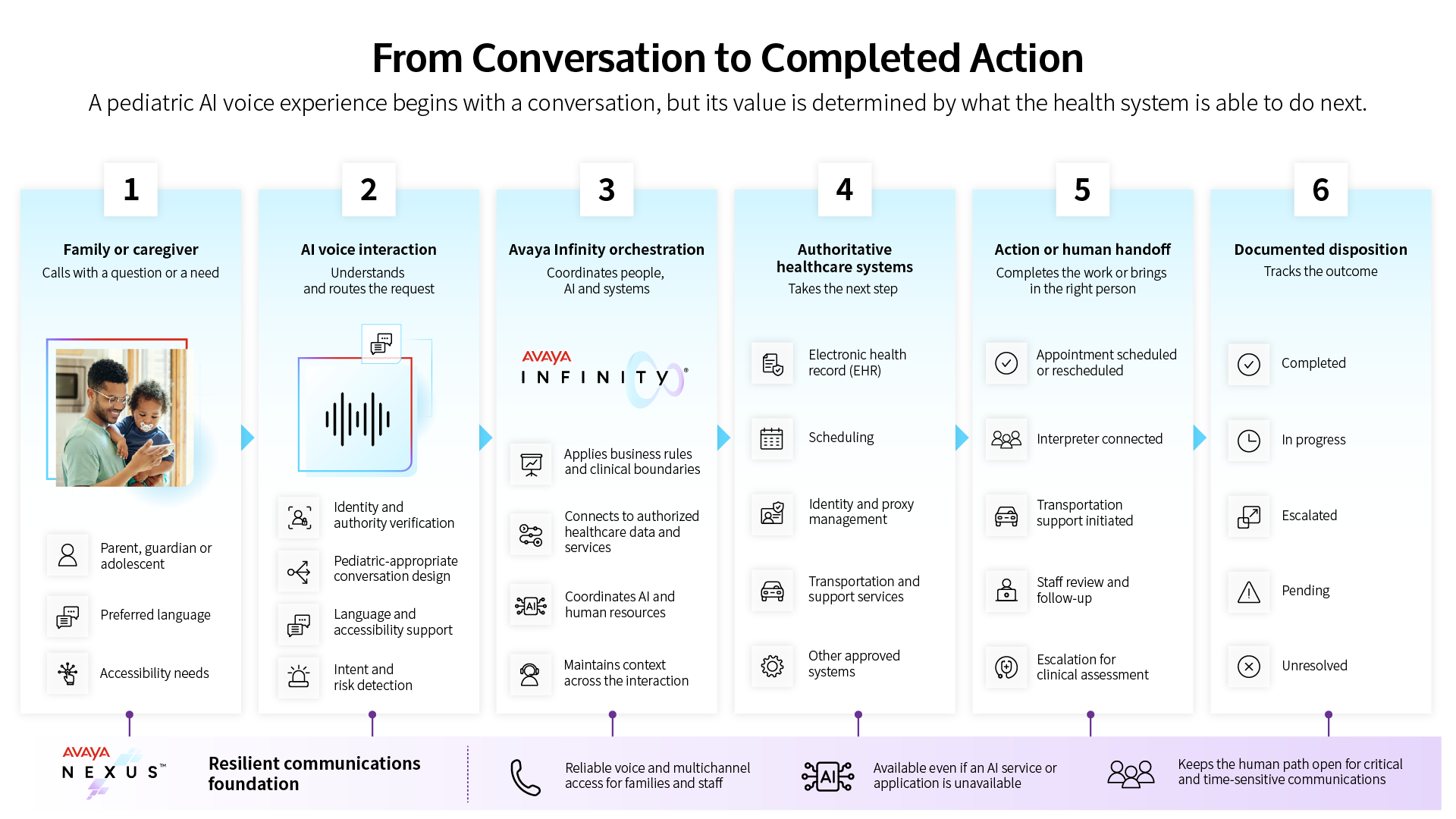
A call creates value when it moves the underlying work. In the rescheduling example, the workflow may depend on identity and proxy data, the appointment record, scheduling rules and inventory, communication preferences, transportation resources, task management, and the final disposition. Each connection should exist because the workflow requires it.
The health system should identify the authoritative source for every decision. The electronic health record may govern demographic, clinical, and encounter information. A scheduling platform may control appointment inventory. Identity services may contribute verification. A language-service platform may provide interpreter access. A community-resource service may support transportation. The design also needs to specify what happens when records conflict, an interface times out, or a downstream team is closed.
Health Level Seven International (HL7) Fast Healthcare Interoperability Resources (FHIR) separates a communication request from a task that can be tracked through states such as requested, accepted, in progress, and completed. The practical difference matters even when a health system uses other technical standards. “We notified the transportation team” does not tell a family whether anyone accepted or completed the request.
A closed-loop program makes the status visible and assigns ownership when the work remains unresolved.
Data should show whether the use case improved the problem it was designed to address. Call attempts, answer rate, duration, and containment describe the interaction itself. A scheduling program also needs outcome data such as completed appointments, time to reschedule, and unresolved barriers. An escalation workflow can track whether the right team received the request and how long resolution took.
Language & Accessibility
How should health systems design pediatric voice AI for language access and accessibility?
Families experience pronunciation, pacing, response time, and tone along with the translated words. Cincinnati Children’s, for example, described developing a local conversation guide to make its AI care assistant sound appropriate for the families it serves. A shared guide can help teams make those choices consistently.
Language access is also where trust becomes very concrete. I live in a community with a large Polish population, and for many parents at my children's school, English is a second language. Navigating the U.S. healthcare system can be difficult even when every instruction is understandable. When information, forms, portals, or automated interactions are not available in a family's preferred language, the burden grows before the healthcare issue itself is even addressed.
Language belongs in the design and test plan from the beginning. Health systems should ask:
- Which languages will the voice agent support at launch?
- How easily can a family change languages or reach an interpreter?
- Will the family’s language preference carry into a human handoff?
- What happens when the requested language is unavailable?
- Has the experience been tested with native speakers and the populations expected to use it?
People most affected by the design should participate in evaluating it. Language-access and accessibility teams belong in use-case selection and procurement, with representative native speakers and people with disabilities included in testing.
Federal civil rights requirements also shape how healthcare organizations approach accessibility across digital technologies. U.S. Department of Health and Human Services (HHS) regulations and guidance address accessibility for people with disabilities and meaningful access for people with limited English proficiency. I’ve studied these issues professionally as well, including authoring research on digital accessibility that HHS later cited in its Section 504 final rule.
Those same considerations carry into voice AI. Families need to be able to understand and use the interaction, change languages when needed, reach an interpreter or staff member, and move to another accessible channel without having to start over.
Accessibility belongs in the architecture, not at the end of a compliance checklist. A pediatric patient, parent, or caregiver may have a hearing, speech, visual, cognitive, or other disability while also needing another language, an interpreter, or a different communication channel. The workflow therefore needs a way to recognize when voice is not the right path, move to an accessible alternative or a person, and preserve enough context that the family does not have to start over.
Avaya brings a long history in communications accessibility to this problem. The company has adopted requirements from Section 508 of the Rehabilitation Act, the European Accessibility Act, and the Accessible Canada Act, publishes product-specific accessibility and conformance information, and contributed to U.S. telecommunications accessibility policy as an invited voting member of U.S. Access Board and Federal Communications Commission (FCC) advisory committees. AI now adds another interface through which families reach healthcare services, bringing that accessibility experience into a new set of interactions.
Human Handoff
When should a pediatric AI voice agent involve a person?
Every use case needs a planned exit. Some triggers are obvious, such as a caller asking for a person or the system being unable to verify authority. Others may emerge during the conversation, including a new symptom, distress, or a service outage. The health system should decide in advance whether each situation requires a transfer, a monitored task, an approved urgent instruction, or another defined response.
When the interaction moves to a staff member, that person needs enough context to continue helping the family. The handoff may include verification status, language preference, the reason for escalation, and the action already attempted, subject to minimum-necessary rules. Families should not have to reconstruct the entire exchange because the technical handoff lost the context.
This is where Avaya’s tandem care approach is especially relevant. Tandem care coordinates AI and human expertise as one service system, with context carried forward as responsibility moves between them. In a pediatric voice workflow, AI can gather permitted information, summarize what has already happened, and coordinate routine steps. A staff member can then take over when the interaction requires empathy, judgment, reassurance, accountability, or specialized knowledge. The family experiences one connected interaction instead of starting over at the handoff.
Voice AI Architecture
What technology and architecture does pediatric voice AI require?
The electronic health record, clinical applications, and health-system governance retain their established roles. Avaya Infinity can help connect the interaction to the context, workflows, communications, and people needed to move the work forward. For the family, the result is practical: the appointment changes, the referral advances, or the request reaches the right team with enough context to continue the work.
Avaya’s Australian technology partner, TazICT, developed a communications architecture framework for a health system customer that offers a useful way to think about this problem. Healthcare organizations often accumulate technologies that work individually while becoming harder to operate as a connected environment. Adding an AI voice agent as another isolated tool can add to that complexity.
TazICT’s framework begins with the communications architecture and integrates other systems where they provide clear value. It also keeps critical communications available when an AI service or business application is down. Applied to pediatric voice AI, the agent can participate in the workflow without becoming the only path a family has to reach a person or complete an essential communication.
In this architecture, Avaya Infinity can coordinate the work surrounding the interaction: applying approved workflow rules, activating permitted context, coordinating voice and digital channels, preserving context during a human handoff, and initiating an authorized action while the family remains engaged. The precise functions depend on the deployment, validated integrations, and the health system’s governance.
Avaya Nexus provides the resilient communications layer when the workflow needs a voice path that remains available during an application or AI-service outage.
Deployment Readiness
What should health systems have in place before deploying pediatric voice AI?
I would begin with one current-state workflow and a named owner. First, document the problem and the population affected. Identify the authoritative data sources, the actions the agent may take, and the teams available when it cannot complete the work. Define what a completed outcome looks like. Then decide whether a voice agent belongs in the response.
- Map the complete journey. Show where the family enters, which systems and teams participate, where exceptions arise, and who owns unfinished work.
- Define authority and limits. Specify what the agent may disclose, collect, complete, refuse, or route for every caller relationship and use case.
- Test the unsuccessful journey. Demonstrate what the family hears, what staff receive, what reaches the record, and who acts when a dependency fails.
- Measure the original problem. Track completed action, completed escalation, unresolved need, family experience, and performance by language or relevant population.
- Give governance practical authority. The responsible team should be able to pause a language, intent, campaign, integration, or model and restore an earlier approved version.
Pediatric AI Voice Agents: Frequently Asked Questions
What is a pediatric AI voice agent?
A pediatric AI voice agent is a conversational system that typically interacts with a parent, caregiver, or authorized proxy and may also interact directly with an adolescent or child when the approved workflow permits it. Depending on the approved workflow, it may support scheduling, appointment preparation, referral follow-up, structured information collection, documentation, barrier identification, or transfer to a person.
Can a pediatric AI voice agent speak directly with a pediatric patient?
It depends on the patient’s age, the topic, applicable law, health-system policy, and the purpose of the workflow. The health system should define when parental permission, adolescent assent, privacy protections, or direct human involvement applies. The agent should not infer permission when identity or authority is uncertain.
How should a pediatric AI voice agent handle another language?
Language requirements should be defined during procurement and workflow design. Health systems should evaluate language switching, pronunciation, comprehension, tone, repetition, and error rates, interpreter access, escalation, and completed outcomes across language groups. Translation alone does not establish an equivalent experience.
When should a pediatric AI voice agent involve a person?
Human involvement is appropriate when identity or authority cannot be verified, the caller requests a person, the request exceeds the approved scope, a clinically ambiguous or high-risk statement appears, or a system failure prevents safe completion. Each workflow needs a named owner and fallback process.
Should the EHR be the source of truth for a pediatric AI voice agent?
The health system should identify the authoritative source for each decision. The EHR may govern identity, proxy, clinical, or encounter information, while other systems may control scheduling, communication preferences, work queues, or resource services. The workflow should define what happens when records are missing, stale, or inconsistent.
How should health systems measure pediatric voice AI?
ROI against the problem the voice agent was introduced to improve. A scheduling use case might track completed appointments, time to reschedule, or unresolved transportation barriers. An escalation workflow might track successful handoffs and time to resolution. Health systems can also monitor opt-outs, family experience, and differences across languages or populations. Call volume, answer rate, and containment are useful operational data, but they don’t show on their own whether the use case improved the outcome it was designed to change.
 Back to Top