Rearchitecting manufacturing customer experience for the MCP generation
AI is transforming how manufacturers serve customers, support distributors and partners, empower employees, and operate across increasingly complex technology environments. But one question stands above the rest: Who controls the future of your customer and employee experiences, your organization or your technology vendors?
At Avaya, we believe the answer should be you. That is why we are embracing the open future of AI, building the Avaya Infinity® platform to support Model Context Protocol (MCP).
It is the right move for manufacturers that need to innovate without abandoning trusted systems, operational data, established workflows, or the security and governance requirements that protect production, customers, partners, and intellectual property.
What is MCP?
MCP stands for Model Context Protocol, an emerging open standard that enables AI models such as GPT, Claude, or Gemini to securely and reliably interact with external tools, data sources, APIs, and user context in a structured way.
For manufacturing, this can give AI access to the context needed to understand a customer, product, order, asset, service request, warranty, distributor relationship, or interaction across multiple systems. Instead of operating in isolation, AI can work with relevant business and operational context, established workflows, permissions, and intent.
The result is AI that can become significantly more useful across customer service, technical support, field service, warranty, aftermarket services, dealer and distributor support, supply chain operations, and other manufacturing environments where speed, accuracy, continuity, and trust matter.
"This is not a 'wait-and-see' moment. Avaya believes the time to be intentional about building the definitive open orchestration engine for the modern enterprise is now."
David Funck, Chief Technology Officer, Avaya
How does MCP work?
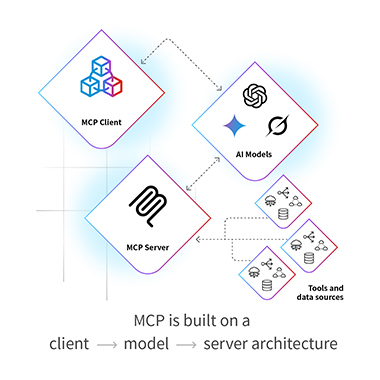
MCP is built on a client → model → server architecture:
- The Client gathers context (user info, role, task, environment).
- The Model (e.g., Claude, GPT) receives the context and a list of available tools or actions.
- The Server hosts the tools (APIs, databases, etc.) and executes any actions the model requests.
All communication follows structured schemas so interactions can be interpretable, traceable, and governed, an important requirement when AI is interacting with customer data, production systems, proprietary product information, and business-critical operational processes.
Avaya Infinity with MCP: Achieving AI-powered manufacturing communications intelligence
Discover how manufacturers can transcend traditional dashboards to analyze experience data, uncover trends, and create real-time views. CX leaders, supervisors, service, operations, and support teams can securely explore vital insights while preserving enterprise data governance.

Removing friction from manufacturing AI with MCP
For too long, bringing AI into manufacturing customer experience has meant choosing between two difficult options:
- Lock in to a single provider's closed ecosystem, limiting flexibility as AI models, products, customer expectations, supply chains, and technology strategies evolve.
- Create costly, one-off integrations across ERP, CRM, order management, field service, warranty, supply chain, product lifecycle management, knowledge systems, dealer platforms, and other applications.
This false choice slows innovation and places additional pressure on already complex manufacturing technology environments. It can also fragment the experience for customers, employees, dealers, and distributors when information is distributed across legacy and modern platforms.
Enter MCP, an open, vendor-agnostic standard designed to help AI models interact with tools, data, and operational logic securely and at scale. Think of MCP as a universal connection layer for AI. Instead of building a different connection between every model and every manufacturing system, organizations can create a standardized way for approved AI capabilities to access the context and tools they need.
As the AI ecosystem evolves, this approach can give manufacturers greater freedom to innovate while maintaining control over the systems, data, workflows, products, and customer relationships that differentiate their business.
MCP enables AI systems to operate with dynamic awareness of customer, employee, session, product, asset, and operational context. For Avaya Infinity, this means AI models can deliver experiences informed by relevant information across complex manufacturing environments. A customer service interaction could draw upon approved CRM, order, warranty, product, service history, knowledge, and interaction data while respecting the permissions governing each source.
That level of contextual intelligence can be especially valuable for manufacturers managing thousands of customers, products, assets, employees, suppliers, dealers, workflows, integrations, and service interactions across multiple regions and channels.
Shaping the future of open AI for manufacturing customer experience
Avaya is not just talking about open AI. We are actively helping shape open standards while bringing native MCP support to Avaya Infinity for secure, model-agnostic, enterprise-ready orchestration. For manufacturers, that creates three important advantages:
- Control: Gain more control over AI models and tools so you can select capabilities based on the requirements of each customer, product, service, or operational use case instead of the limitations of a single vendor.
- Governance: Strengthen interoperability and oversight across customer experience systems, operational data, workflows, applications, and AI so capabilities can be introduced responsibly.
- Future-readiness: Build an AI architecture designed for complex manufacturing environments where security, resilience, interoperability, scalability, and long-term flexibility are essential.
Collaboration with Databricks
As part of our commitment to secure, scalable, and open AI, Avaya is collaborating with Databricks to bring enterprise-grade governance and data privacy capabilities to the MCP implementation within the Avaya Infinity platform. For manufacturers, this approach can help establish controlled access between AI and the structured and unstructured data distributed across customer, product, service, supply chain, operational, and enterprise systems. With fine-grained access controls, audit logging, and governed integration with enterprise data sources, manufacturers can explore AI-powered customer and employee experiences while maintaining greater visibility into how information is accessed and used.
"Generative AI offers tremendous potential to transform customer experiences, and we are thrilled to collaborate with Avaya to help organizations quickly unify their data, simplify data and AI governance and security, and ultimately deliver AI that understands their business."
Heather Akuiyibo, VP of GTM Integration, Databricks
From fragmented manufacturing systems to freedom with MCP
A typical manufacturer may have dozens or hundreds of tools and data sources, including ERP, CRM, order management, product lifecycle management, field service, warranty systems, supply chain platforms, dealer portals, knowledge bases, document repositories, analytics environments, and workforce applications. At the same time, multiple AI models, copilots, applications, and agents may need controlled access to those systems.
Before MCP, connecting each system to each AI model could require its own point-to-point integration. As the number of systems and AI capabilities grows, so does the development effort, maintenance burden, complexity, and technical debt. MCP changes that paradigm by introducing a standardized intermediary layer. Instead of solving an increasingly complex N x M integration problem, manufacturers can move toward a more scalable N + M model. Each manufacturing tool can expose approved capabilities through an MCP server, while AI models and applications connect through MCP clients.
Once components can communicate through MCP, manufacturers gain a more flexible foundation for connecting AI with existing and future systems. That can dramatically reduce redundant integration work while protecting investments already made in the technologies and workflows that support customers, employees, dealers, and partners today. This matters because manufacturing customer journeys rarely live in one application. A single interaction may touch communications, CRM, ERP, order management, product information, warranty, field service, supply chain, dealer systems, knowledge, and analytics. Avaya Infinity with MCP can help connect those technologies, insights, channels, and workflows so manufacturers can modernize the experience without requiring the entire technology environment to be replaced first.
The potential ROI of MCP for manufacturers
With MCP, Avaya Infinity users can unlock deeper business value by giving AI access to more relevant context and approved enterprise capabilities. For manufacturers, that can mean faster customer service, more informed technical support, more efficient field service coordination, stronger dealer and distributor support, greater employee productivity, and better continuity throughout the customer lifecycle.
MCP creates the foundation for generative and agentic AI that is not simply intelligent, but situationally aware of the customer, product, order, installed asset, warranty, service history, and permissions surrounding an interaction.
| Before MCP | After MCP | |
| Integration | Custom connectors between individual AI models and manufacturing systems | A standardized MCP interface can work across models and approved enterprise tools |
| Deployment time | Long, expensive due to bespoke engineering | 50–70% faster, lower costs via reuse (quiq.com, Palma AI, Humanloop, aibase.com) |
| Data access | AI blind to system data, context lost | Full real-time context: CMS, CRM, EHR, ERP |
| Risk management | Employees manually search multiple systems to understand products, orders, warranties, or service needs | AI can help surface relevant customer, product, and service information earlier in the interaction or workflow |
The future of manufacturing AI is open
Manufacturers have spent decades building the products, plants, systems, processes, data, intellectual property, supply networks, service organizations, and customer relationships that differentiate their businesses. They should not have to surrender control of those investments to participate in the AI era.
The world's leading AI technology providers are increasingly embracing open, contextual approaches to AI. Avaya shares that vision. By bringing MCP to enterprise customer experience, Avaya can help manufacturers connect AI with the systems they already trust, adopt the models that best serve each use case, preserve greater control over their architecture, and continuously innovate as the AI ecosystem evolves.
The future of manufacturing customer and employee experience should not be defined by a closed technology stack. It should be defined by what your organization can build, support, and improve next.
Learn how Model Context Protocol reinforces Avaya’s open AI strategy
Glossary
Full glossary of terms below.
| Term | Definition | Why It Matters for Manufacturing |
| MCP (Model Context Protocol) | An open protocol that standardizes how AI models interact with tools, APIs, and memory via structured context objects. | Creates a scalable way to connect AI with ERP, CRM, orders, warranty, field service, product systems, supply chain, and other manufacturing platforms. |
| Context | A bundle of structured information passed to a model—such as user ID, session history, roles, time, or tool availability. | Helps AI understand the customer, employee, product, asset, order, service environment, and situation surrounding an interaction. |
| Model | The generative AI (e.g., Claude, GPT-4, Gemini) that receives the MCP context and generates responses. | Gives manufacturers flexibility to select different AI models based on performance, security, cost, operational, or use-case requirements. |
| Client | The application or interface (e.g., chat window, agent framework, customer portal) that gathers and sends context to the model. | Can include customer portals, employee desktops, dealer applications, virtual assistants, field service tools, and contact center interfaces. |
| Server | The logic layer that hosts tools, APIs, functions, and data sources the model can use via MCP. | Creates a governed way for AI to interact with manufacturing systems without giving models unrestricted access to proprietary or sensitive resources. |
| Tools | Discrete functions or APIs (e.g., “search knowledge base,” “check ticket status,” “update CRM”) exposed to the model via MCP. | Allows AI to move beyond conversation and assist customers, partners, and employees with real manufacturing and service tasks. |
| Schemas | The structured definitions (in JSON or YAML) for how tools and context should be represented and passed to models. | Creates consistency between AI models and manufacturing systems, making integrations easier to understand, govern, scale, and troubleshoot. |
| Memory | Persistent context retained across sessions (user history, preferences, past actions) provided to the model. | Can enable more continuous customer and service experiences so users do not have to repeatedly explain the same product or support issue. |
| Ephemeral Context | Short-lived, session-specific information (e.g., current task, temporary variables). | Helps AI remain focused on the immediate customer or operational need without unnecessarily retaining temporary information. |
| Agent | An AI system that can take actions, invoke tools, and make decisions based on MCP context — often used in autonomous or semi-autonomous workflows. | Provides the foundation for controlled agentic AI that can assist with multi-step customer service, field service, warranty, and operational workflows. |
| Orchestration | Coordinating multiple steps, tools, and model outputs to achieve a higher-order business goal. | Helps manufacturers connect customer interactions with the many systems, teams, suppliers, and processes required to complete complex service journeys. |
| Observability | The ability to inspect what context was passed, what decisions the model made, and how tools were used. | Supports transparency, governance, troubleshooting, security, and oversight when AI interacts with customer, operational, and proprietary information. |
| Interoperability | The ability for different AI models and platforms to work with a shared structure of tools and context. | Gives manufacturers greater flexibility to evolve their AI strategies without replacing established systems or becoming dependent on a single AI provider. |