Critical communications infrastructure for manufacturing
Avaya Nexus provides a secure, resilient voice foundation for manufacturers where communication downtime can disrupt production, worker safety, maintenance, quality, supply chain operations, and business continuity.

Mission-critical voice for manufacturing
Across production plants, control rooms, maintenance teams, warehouses, engineering operations, security, supply chain functions, and customer service centers, voice remains essential when an issue is urgent, complex, or operationally significant.
Avaya Nexus modernizes enterprise voice without forcing a disruptive rip-and-replace, preserving operational control and existing infrastructure investments while introducing a cloud-native, zero-downtime architecture designed for complex and high-stakes environments.
The manufacturing communications landscape has shifted
Manufacturing is becoming increasingly connected. Automation, robotics, IoT, predictive maintenance, digital twins, analytics, AI, and connected supply chains are transforming how products are designed, produced, maintained, and delivered.
But increasingly automated operations make resilient human communication more important, not less. When a line stops, equipment fails, a safety event occurs, a quality issue emerges, or a shipment is disrupted, teams may need to coordinate immediately across production, maintenance, engineering, operations, security, logistics, and management.
Voice is also increasingly connected to notification systems, workflows, analytics, transcription, automation, and AI-supported processes. That makes availability, security, interoperability, voice quality, and operational control more important than ever. Avaya Nexus is designed for these infrastructure-level requirements.
"The continuity of government services depends on a host of resilient and secure communications, from processing benefits to coordinating emergency logistics. We're proud to partner with an industry stalwart like Avaya leading with the innovation needed to ensure our most-mission-critical connections are reliably consistent for the government and public when they are needed most."
Michael Hanke Section Chief, Telecom Operations, U.S. Immigration and Customs Enforcement

What is critical communications infrastructure in manufacturing?
Critical communications infrastructure is the modern evolution of enterprise voice for industrial environments where communication failure can create immediate production, safety, operational, or financial consequences.
It is designed to support:
- Zero-downtime communications for critical manufacturing operations
- High availability during plant incidents, maintenance events, and infrastructure disruption
- Resilient communications across factories, warehouses, offices, and distributed facilities
- Security, identity governance, and operational accountability
- Integration with notification, workflow, collaboration, radio, and operational systems
- Cloud-native scalability without unnecessarily disrupting existing infrastructure investments
For manufacturers, voice is more than an employee collaboration tool. It is part of the operational infrastructure that keeps production moving.
The standard for manufacturing critical communications
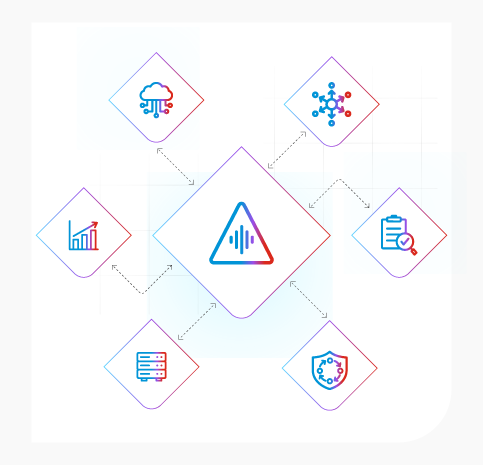
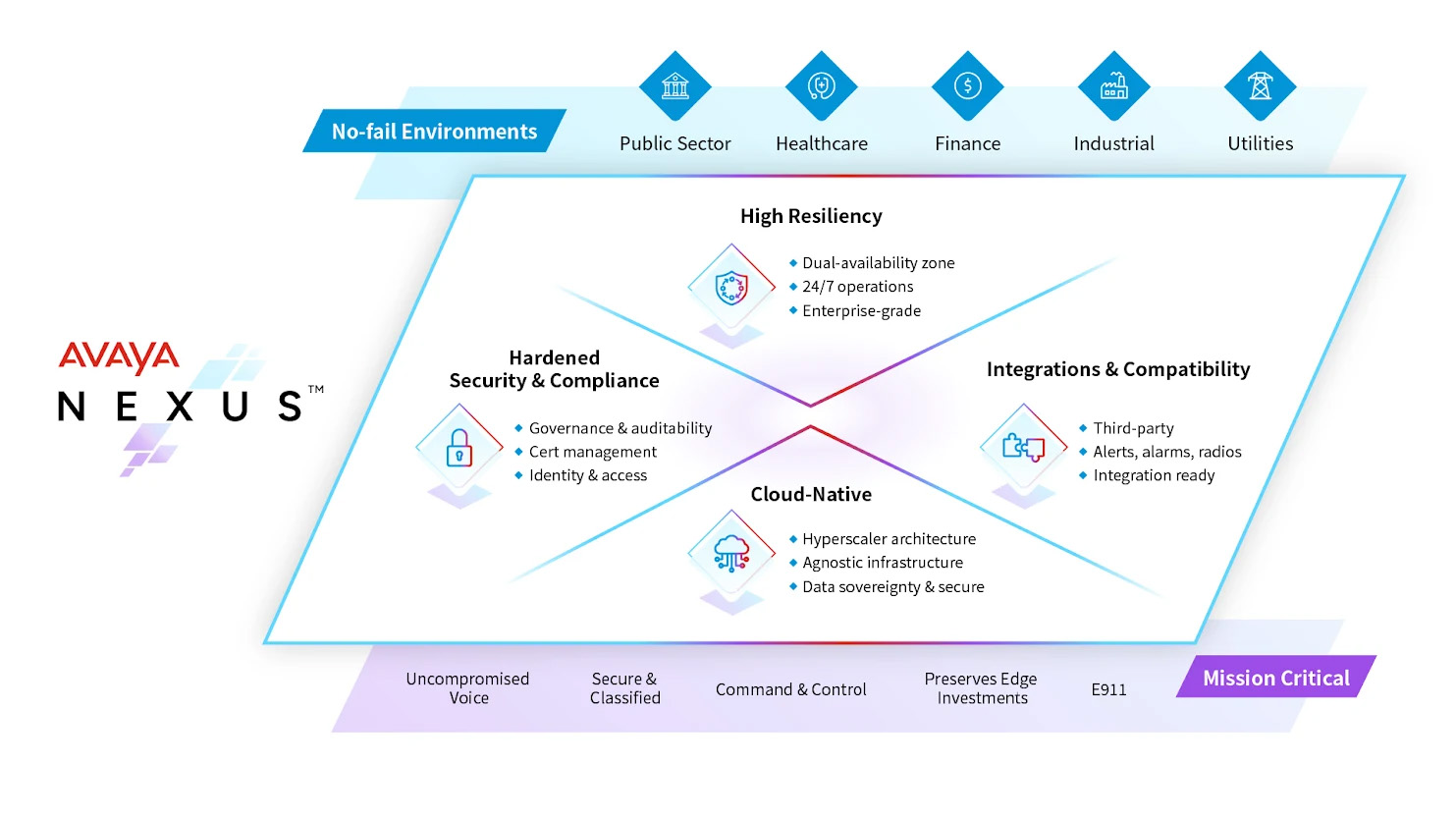
Avaya Nexus combines four foundational capabilities for critical manufacturing communications: high resiliency, hardened security and compliance capabilities, deployment flexibility, and integration readiness.
For manufacturing environments where communications cannot fail
Avaya Nexus can support environments such as:
- Production plants
- Industrial campuses
- Control rooms and operations centers
- Maintenance and engineering operations
- Warehouses and distribution centers
- Security and emergency response
- Quality and production management
- Global manufacturing networks
These environments require more than bundled telephony. They require resilient infrastructure.
Critical manufacturing communications must be engineered with reliability, security, governance, integration, and operational control as foundational principles.
"Strengthening resilient communications capabilities is essential to ensuring continuity of critical infrastructure operations.."
U.S. Department of Energy, Resilient Communication Systems, 2025

What is aging voice infrastructure costing your manufacturing operation?
Outdated voice systems create risks like security vulnerabilities, unsupported components, higher costs, complexity, skills shortages, outages, integration challenges, and operational disruptions. When communications support plant operations, system limits restrict performance. Use the Voice Infrastructure Impact Model to evaluate your environment and build a case for modernization.
Security, compliance, and governance for manufacturing communications
Avaya Nexus is designed to support rigorous security and operational requirements in complex industrial environments.

Encryption
TLS-encrypted signaling and SRTP-secured media

Identity & access management
Single Sign-On (SSO), Multi-Factor Authentication (MFA), role-based access controls

Certificate management
Centralized certificate lifecycle management and governance

Audit & monitoring
Logging, monitoring, and audit-ready operational controls

Deployment security
Support for data sovereignty and controlled deployment environments

Operational resilience
Zero-downtime architecture with redundancy and failover design
For manufacturing Avaya Aura environments
Avaya Aura provides resilient enterprise voice for complex manufacturing. Avaya Nexus builds on this with zero-downtime architecture, enhanced security, cloud-native extensibility, and infrastructure flexibility—without abandoning proven investments. Avaya Aura Communication Manager, Enablement Services, and Session Border Controller remain integral, alongside a modern containerized foundation.

“Unified communications: Not all seats are the same”
Office employees on routine collaboration calls have different communication needs than maintenance teams recovering a stopped production line. Critical manufacturing communications depend on infrastructure designed for high-consequence failure.

Frequently asked questions about Avaya Nexus for manufacturing
What is critical communications infrastructure in manufacturing?
Critical communications infrastructure is the secure, resilient foundation that helps people stay connected when manufacturing operations depend on timely communication. It supports activities such as production, maintenance, safety, emergency response, quality, logistics, and business continuity—where a communications failure can make an operational problem harder to resolve.
How can Avaya Nexus support plant uptime?
When a production issue occurs, operations, maintenance, engineering, management, suppliers, and field personnel may need to coordinate quickly. Avaya Nexus provides resilient voice infrastructure designed around availability, redundancy, failover, survivability, and operational monitoring, helping ensure that communications do not become an additional obstacle to recovery.
How is Avaya Nexus different from a traditional unified communications platform?
Traditional unified communications platforms are generally designed for meetings, messaging, and everyday collaboration. Avaya Nexus is designed for environments that need resilient critical voice, controlled deployment, strong identity governance, secure communications, and continued service during maintenance or disruption. Manufacturers can use collaboration tools for routine interactions while maintaining a separate foundation for communications essential to operations.
Is Avaya Nexus an industrial control system or an OT platform?
No. Avaya Nexus is critical communications infrastructure, not an industrial control system or Operational Technology platform. It does not replace systems such as SCADA, Distributed Control Systems, Programmable Logic Controllers, or manufacturing execution systems. Instead, it provides voice communications that can help people coordinate around those specialized systems.
Can Avaya Nexus integrate with manufacturing systems such as MES, SCADA, or plant alarms?
Avaya Nexus provides API-driven interoperability that can support communications within broader enterprise workflows. Depending on the systems, interfaces, security architecture, and use case, workflows may connect communications with MES events, SCADA-related alerts, alarms, or notifications. These integrations should be carefully designed and validated, and Nexus does not replace the manufacturing systems themselves.
Can Avaya Nexus support plant emergency communications and worker safety?
Avaya Nexus can provide resilient voice infrastructure as part of a broader emergency communications and worker safety strategy. During an incident, teams may need to coordinate across operations, safety, security, maintenance, facilities, and emergency responders. Nexus does not replace safety procedures, alarms, protective equipment, specialized safety systems, or employee training.
Can Avaya Nexus support manufacturing operations that run 24x7?
Yes. Many plants operate continuously, so communications may be needed at any hour and there may be no convenient time for an outage. Avaya Nexus is architected for continuous service during maintenance and upgrades, helping manufacturers reduce the need to choose between infrastructure maintenance and communications availability.
What does plant survivability mean, and how can Avaya Nexus support it?
Plant survivability is the ability of a manufacturing location to maintain essential communications if its connection to centralized systems or services is disrupted. Avaya Nexus includes nodal failover and location survivability capabilities that can help individual plants maintain communications during an interruption. The level of survivability depends on the architecture and configuration selected.
How can Avaya Nexus support a manufacturing cybersecurity strategy?
Avaya Nexus includes communications security and governance capabilities such as encrypted signaling and media, centralized identity management, Single Sign-On, Multi-Factor Authentication, role-based access controls, certificate lifecycle management, logging, and monitoring. These capabilities can contribute to a broader cybersecurity strategy, but security depends on the complete environment—including networks, applications, endpoints, policies, people, and processes.
What deployment options does Avaya Nexus support?
Avaya Nexus supports flexible deployment models, including dedicated cloud and on-premises configurations using supported hyperscaler environments such as Azure, Google Cloud, AWS, and Oracle Cloud Infrastructure. This gives manufacturers options for aligning infrastructure with security, operational control, data residency, plant connectivity, and existing investments.
Can manufacturers modernize to Avaya Nexus without replacing everything at once?
Yes. Avaya Nexus is designed as an evolution of Avaya Aura, preserving key existing infrastructure components while introducing a modern, containerized architectural foundation. Manufacturers can plan phased modernization around production schedules, plant requirements, application dependencies, and investment cycles rather than forcing every site to migrate at the same time.
How can Avaya Infinity and Avaya Nexus work together during a production issue?
Avaya Infinity can help orchestrate workflows that bring together employee context, equipment information, maintenance systems, knowledge resources, AI, and human expertise. When an issue requires a conversation with an engineer or specialist, Avaya Nexus can provide the resilient voice foundation for that interaction. Specific workflows depend on the manufacturer’s applications, integrations, and architecture.
Resources for regulated industries
When communications underpin production, worker safety, maintenance, quality, and operational continuity, they cannot be treated as optional layers.
Avaya Nexus is built for manufacturing environments where communications must simply work.
Contact us about
Avaya Nexus
Request a product preview