Journeys DC Panel: When Public Sector Communications Can’t Fail
Leaders from ICE and New York City Public Schools discussed mission-critical voice, contact center modernization, zero trust, and the role of Avaya Nexus and Avaya Infinity in high-stakes public sector environments.
WASHINGTON, DC (May 6, 2026) - For public sector leaders, modernization depends on a communications infrastructure that can support mission-critical voice, emergency response, contact center operations, school safety, and citizen services.
That reality shaped Avaya Journeys DC, held April 23, 2026, at the Ronald Reagan Building and International Trade Center in Washington, D.C. Michael Hanke, Telecommunications Operations Chief at U.S. Immigration and Customs Enforcement, and Alex Williams, Deputy Chief Information Officer and Chief Technology Officer at New York City Public Schools, brought different missions to the same question: what modernization means when seconds matter.
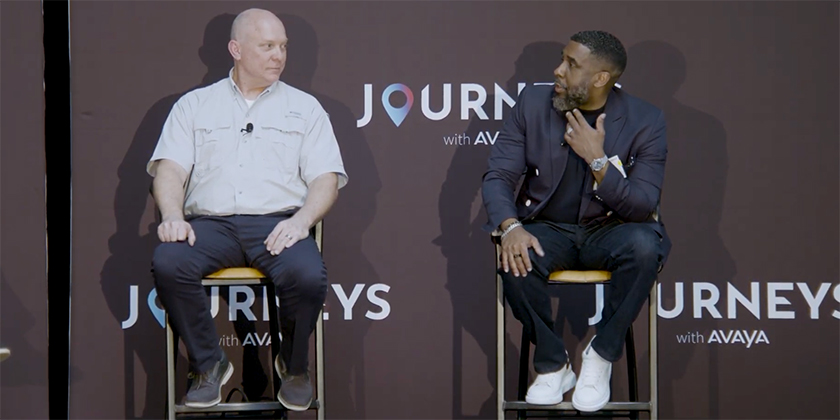
Both operate at a scale where communications failure can quickly become operational failure. Hanke supports a geographically dispersed federal law enforcement agency with 350 locations, seven contact centers, and a multi-year strategy to move from fragmented unified communications environments to a flatter, cloud-ready architecture. Williams supports the nation’s largest public school system, with more than 960,000 students, roughly 70,000 employees, and more than 1,600 schools.
When a Communications Failure Becomes an Operational Failure
“Critical communications really boils down to life or death,” Hanke said. “Those are the communications that cannot be interrupted, cannot be stopped, and must be allowed to go through."
Williams described the same standard in the context of school safety. During a lockdown, weather event, or transportation disruption, communications have to hold. “It just needs to work.”
In both environments, communications extend well beyond phone calls. Hanke described systems that connect officers, headquarters, field teams, and operations centers. Williams pointed to an environment where phones, transportation, video surveillance, door access, police coordination, and parent communications all have to function together in real time.
Speed adds another layer of pressure. Williams said NYCPS is working to prevent situations where information about an incident reaches families through students or social media before the school system can communicate officially. When that happens, confusion can spread faster than guidance. The goal is to ensure accurate information moves just as quickly.
The Foundation for Public Sector Modernization
Avaya Chief Executive Officer Patrick Dennis said the company’s direction reflects what public sector customers asked for at last year’s event.
“Last year you told us, don’t forget the high-quality, low-latency voice makes the world go round,” Dennis said. “With Avaya Nexus, we came back with an answer to that challenge.”
Across the day, Avaya leaders and customers returned to that point through discussions about migration paths, hybrid and on-premises requirements, security controls, sovereignty, and the need to preserve the communications environments agencies already trust while modernizing around them.
While Dennis reiterated that “Avaya Aura is not going away,” he positioned Avaya Nexus as the next step for agencies that need to modernize their communications infrastructure without losing control of reliability, security, or deployment flexibility. Nexus is designed to support mission-critical voice and communications environments across on-premises, hybrid, and cloud architectures, giving agencies a path forward when existing systems can no longer meet new operational or security demands.
Trust Determines How Fast Modernization Can Move
For Williams, modernization at NYCPS has depended on more than the technical migration plan. As the district prepared to migrate its first group of agents to Avaya Infinity, Avaya’s platform for orchestrating service experiences across systems, data, AI, and workflows, Williams said the decision came down to trust in Avaya.
“We've been able to build a sense of trust with Avaya and then also with the users that I am supporting,” Williams said. “And that takes time.”
Public sector modernization rarely starts from a clean slate. Williams described the move as a transition from a fragmented environment to a more connected platform, with the first group of agents scheduled to move after months of preparation. Confidence came from having trust, a plan, “the right people in the room” if issues arise.
Hanke described modernization as a long-term effort with a defined end state but constant adjustment along the way. Challenges are expected. That makes modernization less a project and more an ongoing “journey” that requires communication and alignment across the organization.
Security Has to Protect Access Without Slowing the Mission
Security is another constraint shaping modernization decisions. Both leaders described the security model, zero trust, as a practical requirement rather than a theoretical model.
In this context, zero trust means verifying every access request and tightly controlling how data moves across systems. For Hanke, the challenge is how the new platform fits into ICE’s existing security architecture and data controls.
Williams described a similar approach at NYCPS, which relies heavily on Zscaler Private Access. He framed zero trust as securing every door while ensuring the right people can still get through the right ones.
That balance is difficult in practice. School systems serve a wide range of users, from teachers and administrators to students, families, and external partners. Each requires different levels of access, often to sensitive information. The goal is to protect that data while still enabling faster responses and better service.
The Decisions Behind Modernization
The panel, moderated by Avaya’s Chief Revenue and Customer Experience Officer Marylou “ML” Maco, closed on what determines whether modernization holds up over time.
Williams said agencies need to modernize mindsets alongside technology, involve the right stakeholders early, and understand the difference between a vendor and a partner:
“As we think about modernization, make decisions that are going to outlive you. Help the next person that comes into this role and make it easier for them to continue on for success.”
Hanke emphasized communication as a non-negotiable. Teams need to keep explaining the plan internally and externally so leaders, users, and partners understand where the organization is going.
The message from Washington was clear: public sector modernization is not about replacing what agencies already trust. It is about strengthening the communications foundation they depend on and extending it with the capabilities their missions now require.
Avaya Journeys continues in cities around the world, bringing customers, partners, and experts together to explore how AI, cloud, and next-generation communications are shaping customer and critical experiences. Learn more about upcoming Avaya events.
About Avaya
Avaya is an enterprise software leader that helps the world’s largest organizations and government agencies forge unbreakable connections.
Learn more at https://www.avaya.com.