Critical communications infrastructure for healthcare
Avaya Nexus provides a secure, resilient voice foundation for healthcare organizations where communication downtime can disrupt care, delay response, and affect patient safety.

Mission-critical voice for healthcare
Across hospitals, clinics, emergency departments, and care networks, voice supports clinical coordination, emergency response, patient access, and operational continuity.
Avaya Nexus modernizes enterprise voice without forcing a disruptive rip-and-replace—preserving infrastructure investments while introducing a cloud-native, zero-downtime architecture.
The healthcare communications landscape has shifted
Healthcare organizations now rely on specialized platforms for clinical collaboration, patient engagement, emergency notification, virtual care, and operational workflows.
But critical voice operates under different requirements. Communications must remain available during emergencies, demand surges, maintenance, and infrastructure disruption.
Voice is also increasingly connected to automation, documentation, analytics, and AI-supported workflows, making reliability and governance more important than ever.
Avaya Nexus is designed for these infrastructure-level requirements.
"From the very beginning, we attached great importance to the development of a highly available geo-redundancy concept."
Jan Paul Deputy IT Manager, Buchholz and Winsen Hospitals

What is critical communications infrastructure in healthcare?
As healthcare communications become more diverse, the resilient voice foundation beneath them becomes more important.
Critical communications infrastructure is the modern evolution of enterprise voice for healthcare environments that cannot tolerate failure.
It is designed to support:
- Zero-downtime clinical operations
- High availability during emergencies and peak demand
- Controlled deployment aligned with healthcare requirements
- Security, compliance, and identity governance
- Integration with clinical and operational workflows
- Cloud-native scalability without disrupting existing investments
In healthcare, voice is not simply a feature. It is infrastructure.
The standard for healthcare communications
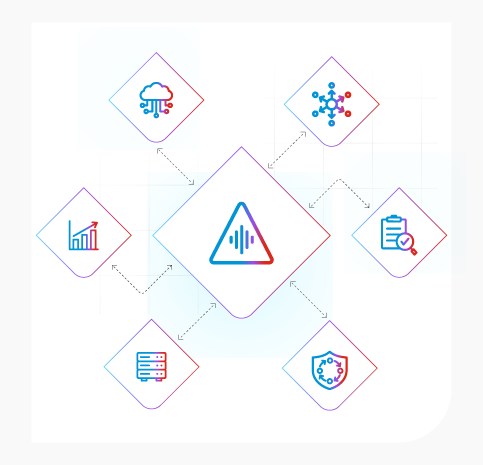
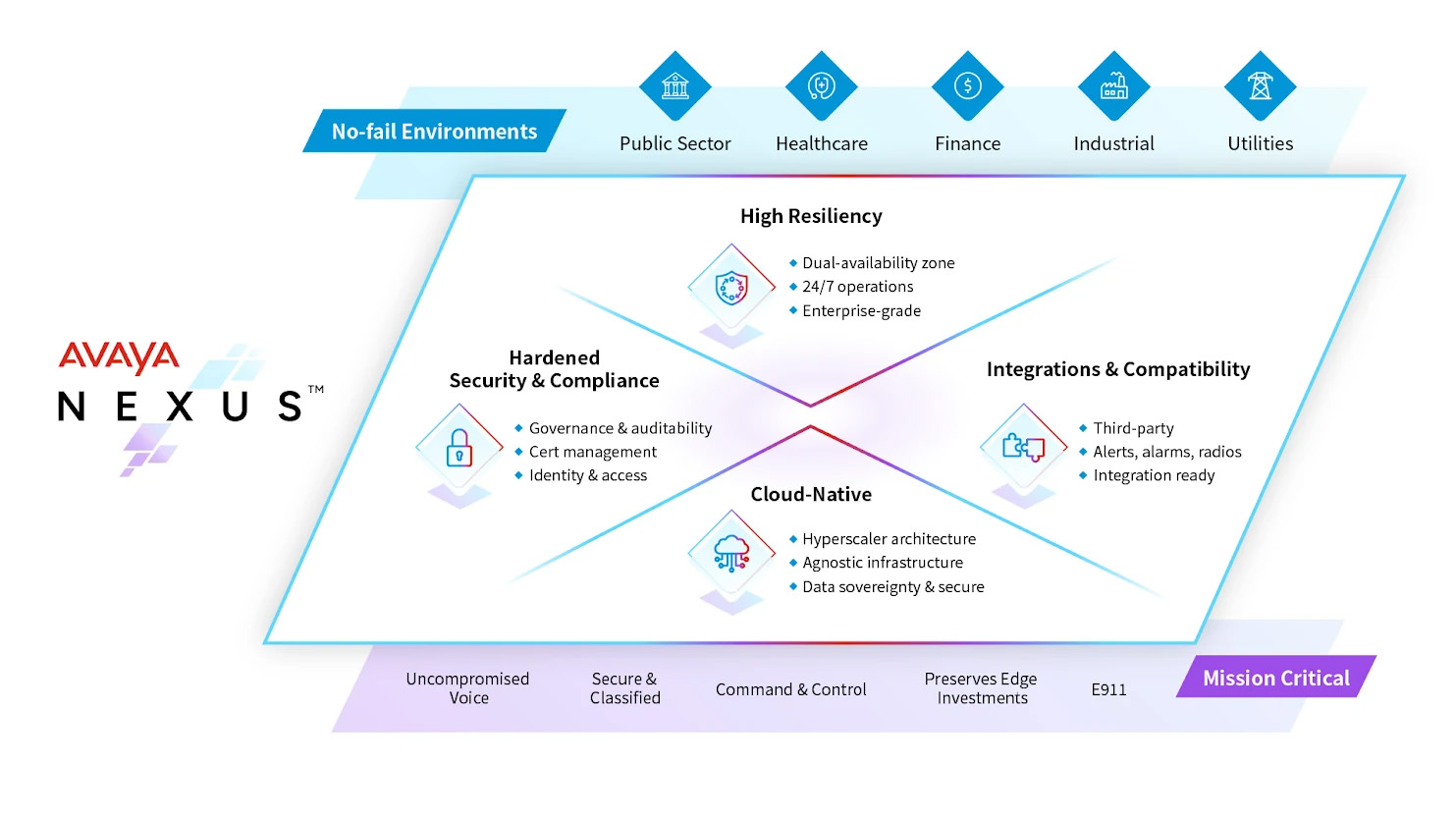
Avaya Nexus combines four foundational capabilities: high resiliency, hardened security and compliance, deployment flexibility, and integration readiness.
For healthcare environments where communications cannot fail
Avaya Nexus is purpose-built for:
- Hospitals and health systems
- Emergency departments and trauma centers
- Clinical command centers
- Patient access and transfer centers
- Ambulatory and outpatient facilities
- Healthcare contact centers
- Distributed care networks
These environments require more than bundled telephony. They require resilient infrastructure.
Critical healthcare communications must be engineered with reliability, governance, and operational control as foundational principles.
"In healthcare, communication resilience is part of care resilience."

What is aging voice infrastructure costing you?
Outdated voice systems introduce hidden risks—from security vulnerabilities and rising maintenance costs to outages that can disrupt care.
Use the Voice Infrastructure Impact Model to evaluate your environment and build a data-backed case for modernization.
Security, compliance, and governance for healthcare communications
Avaya Nexus is designed to support the rigorous requirements of regulated and mission-critical healthcare environments.

Encryption
TLS-encrypted signaling and SRTP-secured media.

Identity and access management
SSO, MFA, and role-based access controls.

Certificate management
Centralized certificate lifecycle management and governance.

Audit and monitoring
Logging, monitoring, and audit-ready operational controls.

Deployment security
Support for controlled deployment and data residency requirements.

Operational resilience
Zero-downtime architecture with redundancy and failover.
For Avaya Aura healthcare environments
Avaya Aura has long provided a resilient enterprise voice foundation for healthcare organizations.
Avaya Nexus builds on that foundation with zero-downtime architecture, strengthened security, cloud-native extensibility, and flexible deployment—without requiring healthcare organizations to abandon important investments.

“Unified communications: Not all seats are the same”
A clinician responding to an emergency has different communications requirements from an employee joining a routine meeting. Hear Avaya CEO Patrick Dennis explain why organizations must distinguish general collaboration from communications that support safety, continuity, and community well-being.

Frequently asked questions about Avaya Nexus for healthcare
What is critical communications infrastructure in healthcare?
Critical communications infrastructure is the secure, resilient communications foundation used for healthcare activities where availability, clarity, governance, and operational control are essential.
These activities can include clinical escalation, emergency response, care team coordination, patient access, transfer center operations, incident management, and other time-sensitive workflows.
Unlike general-purpose unified communications platforms, critical communications infrastructure is engineered for environments where system failure can produce immediate operational consequences.
Why is voice still mission-critical in healthcare?
Voice remains one of the fastest and most direct ways to coordinate care, escalate urgent situations, reach on-call personnel, support patients, manage emergencies, and communicate when a workflow cannot wait.
Voice also increasingly supplies input to transcription, analytics, documentation, automation, and AI-supported systems. As a result, voice availability and quality can influence both immediate communication and downstream healthcare workflows.
How is Avaya Nexus different from a traditional unified communications platform?
Traditional unified communications platforms are generally optimized for employee productivity, meetings, messaging, and collaboration.
Avaya Nexus is architected for healthcare and other high-stakes environments that require:
- Zero-downtime reliability
- Controlled deployment
- Strong identity governance
- Encrypted communications
- Operational monitoring
- Integration with critical workflows and systems
- Continued operation during maintenance or disruption
It provides a resilient voice core that can work alongside the collaboration tools selected by the healthcare organization.
Is Avaya Nexus a clinical collaboration application?
No. Avaya Nexus is a modern, open voice infrastructure.
It is designed to provide a hardened, enterprise-controlled communications foundation that can integrate with clinical collaboration, notification, workflow, contact center, and third-party applications.
This allows healthcare organizations to select specialized tools while maintaining a resilient voice core beneath them.
Does Avaya Nexus support zero-downtime healthcare operations?
Avaya Nexus is architected for zero-downtime operations through redundancy, failover, dual-availability-zone deployment models, service isolation, and continuous operation during maintenance and upgrades.
These capabilities are intended to help healthcare communications remain available during infrastructure disruption, scheduled change, or periods of elevated demand.
What deployment options does Avaya Nexus support?
Avaya Nexus supports flexible deployment models, including dedicated cloud and on-premises hyperscaler environments.
Supported infrastructure strategies can include environments based on Azure, Google Cloud, AWS, and Oracle Cloud Infrastructure configurations.
This flexibility helps healthcare organizations align deployment with their security, data residency, infrastructure control, and operational requirements.
The Health Status Dashboard also provides enhanced visibility into platform condition and service health, supporting proactive oversight.
How does Avaya Nexus support healthcare security and compliance requirements?
Avaya Nexus provides capabilities such as:
- TLS-encrypted signaling
- SRTP-secured media
- Centralized identity and access management
- Single Sign-On
- Multi-Factor Authentication
- Role-based access controls
- Centralized certificate lifecycle management
- Logging and monitoring
- Audit-ready operational controls
- Controlled deployment options
- Resilient architecture
These capabilities can support the technical and operational controls within a healthcare organization’s broader privacy, security, risk management, and compliance programs.
Does Avaya Nexus make a healthcare organization HIPAA compliant?
No single technology makes an organization HIPAA compliant.
Compliance depends on the organization’s complete combination of technologies, policies, processes, safeguards, workforce practices, vendor relationships, and risk management controls.
Avaya Nexus provides communication security, access governance, encryption, monitoring, deployment, and availability capabilities that can support healthcare organizations operating in HIPAA-regulated environments.
Can Avaya Nexus support regional data residency requirements?
Yes. Avaya Nexus supports controlled deployment models that can be aligned with regional data residency and sovereignty requirements.
Healthcare organizations can select deployment environments appropriate to local mandates, organizational policies, physical security requirements, and infrastructure strategies.
How scalable is Avaya Nexus for large health systems?
Avaya Nexus is designed to scale across large, distributed enterprise environments.
Its containerized microservices architecture supports geographic distribution, high concurrency, and enterprise performance requirements. This makes it suitable for healthcare systems operating across hospitals, clinics, administrative facilities, contact centers, and remote locations.
Can Avaya Nexus support healthcare mergers and acquisitions?
Avaya Nexus can provide a common modernization foundation for organizations managing multiple communications environments across acquired hospitals, clinics, or regional networks.
Its integration capabilities, deployment flexibility, and support for existing Avaya Aura elements can help healthcare organizations move toward a more consistent architecture without requiring every location to be replaced at once.
The specific transition strategy will depend on the infrastructure, integrations, and operating requirements of each organization.
How does Avaya Nexus support existing Avaya Aura healthcare customers?
Avaya Nexus provides a modernization path for Avaya Aura environments seeking cloud-native architecture, greater agility, enhanced resilience, and flexible infrastructure deployment.
It is designed as an evolution of the existing environment rather than a complete abandonment of it.
Avaya Aura Communication Manager, Avaya Enablement Services, and Avaya Session Border Controller remain integral to the solution while Avaya Nexus introduces a modern, containerized architectural foundation.
What is the connection between Avaya Infinity and Avaya Nexus in healthcare?
Avaya Infinity and Avaya Nexus address two connected healthcare priorities.Avaya Infinity helps orchestrate patient and employee experiences across voice, digital channels, AI, enterprise data, and workflows.
Avaya Nexus provides the resilient, secure, mission-critical voice infrastructure beneath communications that must remain available.
Together, they enable healthcare organizations to pursue digital and AI innovation while protecting the reliability of essential voice communications.
What role does AI play in Avaya Nexus?
Avaya Nexus provides the resilient voice foundation required by AI-supported capabilities such as transcription, translation, summarization, analytics, keyword detection, and automated workflows.
As AI systems depend on voice input, the quality, continuity, and governance of that input become increasingly important.
Avaya Nexus helps ensure that innovation is supported by communications infrastructure designed for reliability and operational control.
Why does voice clarity matter in healthcare?
Poor voice quality can create confusion, repetition, transcription errors, patient frustration, and difficulty understanding time-sensitive information.
As voice becomes an input for clinical and operational workflows, audio integrity can also affect the accuracy of downstream transcription, analytics, and automation.
Clear, dependable voice supports human understanding, patient confidence, and more reliable technology-assisted processes.
Can Avaya Nexus integrate with electronic health records?
Avaya Nexus provides API-driven interoperability and a voice infrastructure designed to work within a broader healthcare technology ecosystem.
Specific integration with an electronic health record, clinical workflow, notification platform, or other application depends on the use case, available interfaces, implementation design, and selected Avaya or partner capabilities.
Can Avaya Nexus integrate with emergency notification and clinical alerting systems?
Avaya Nexus is designed for integration readiness across notification, workflow, collaboration, and operational systems.
This can support communications strategies involving emergency alerts, clinical escalation, incident response, on-call coordination, and other time-sensitive workflows.
The exact integration architecture should be validated for each healthcare environment and use case.
Resources for healthcare and regulated industries
When communications underpin patient safety, clinical coordination, emergency response, regulatory accountability, or operational continuity, they cannot be treated as an optional layer.
Avaya Nexus is built for healthcare organizations where communications must simply work.
Contact us about
Avaya Nexus
Request a product preview