Critical communications infrastructure for financial services
Avaya Nexus provides a secure, resilient voice foundation for financial institutions where communication downtime can disrupt fraud response, customer service, financial operations, regulatory workflows, and customer trust.

Mission-critical voice for financial services
Across fraud operations, customer service centers, branches, wealth management, card services, lending, treasury operations, and distributed financial services environments, voice remains essential to customer confidence and operational continuity.
Avaya Nexus modernizes enterprise voice without forcing a disruptive rip-and-replace, preserving operational control and existing infrastructure investments while introducing a cloud-native, zero-downtime architecture designed for regulated and high-stakes environments.
The financial services communications landscape has shifted
Financial services has become increasingly digital. Customers can open accounts, transfer funds, manage cards, apply for loans, make payments, and interact with their institution from almost anywhere.
But when money is at risk, an account is compromised, a transaction is questioned, or a financial decision becomes complex, customers often still turn to voice.
At the same time, voice is increasingly connected to fraud systems, authentication, recording, compliance workflows, analytics, automation, and AI-supported processes. That makes reliability, security, governance, voice integrity, and operational control more important than ever.
Avaya Nexus is designed specifically for these infrastructure-level requirements.
"The continuity of government services depends on a host of resilient and secure communications, from processing benefits to coordinating emergency logistics. We're proud to partner with an industry stalwart like Avaya leading with the innovation needed to ensure our most-mission-critical connections are reliably consistent for the government and public when they are needed most."
Michael Hanke Section Chief, Telecom Operations, U.S. Immigration and Customs Enforcement

What is critical communications infrastructure in financial services?
As financial services experiences become more digital and distributed, the resilient voice foundation beneath critical interactions becomes more important.
Critical communications infrastructure is the modern evolution of enterprise voice for financial services environments that cannot tolerate failure.
It is designed to support:
- Zero-downtime communications for critical financial operations
- High availability during fraud events, demand surges, and infrastructure disruptions
- Controlled deployment aligned with security, regulatory, and data residency requirements
- Security, identity governance, and operational accountability
- Integration with fraud, workflow, recording, notification, collaboration, and customer engagement systems
- Cloud-native scalability without disrupting existing infrastructure investments
For financial institutions, voice is not simply another customer channel. It is part of the institution's trust infrastructure.
The standard for financial services critical communications
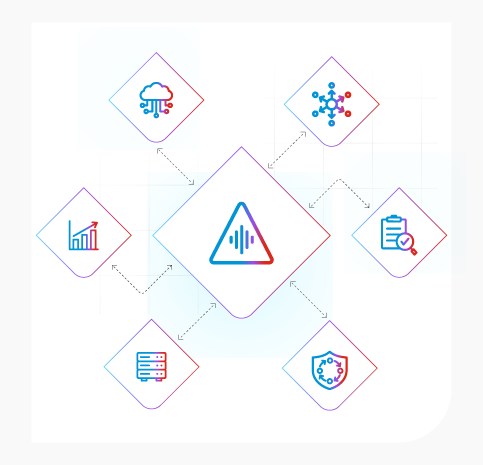
Avaya Nexus combines four foundational capabilities for critical financial communications: high resiliency, hardened security and compliance capabilities, deployment flexibility, and integration readiness.
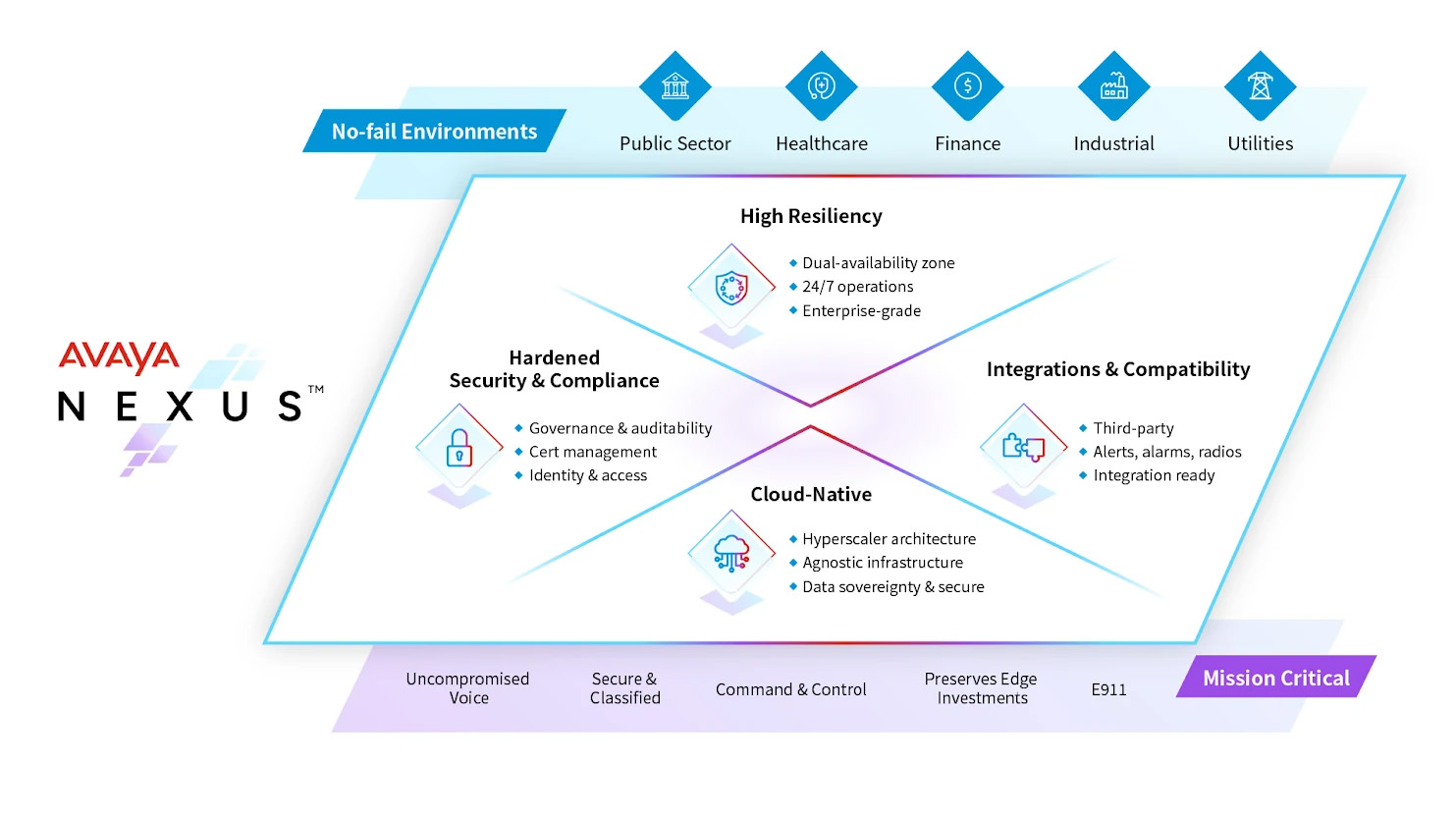
For financial environments where communications can’t fail
Avaya Nexus is purpose-built for environments such as:
- Fraud prevention and response operations
- Retail and commercial financial contact centers
- Wealth management and private banking
- Card and payment services
- Lending and mortgage operations
- Treasury and financial operations
- Branch and regional financial networks
- Customer authentication and escalation workflows
These environments require more than bundled telephony. They require resilient infrastructure.
Critical financial communications must be engineered with reliability, governance, security, integration, and operational control as foundational principles.
"Strengthening resilient communications capabilities is essential to ensuring continuity of critical infrastructure operations.."
U.S. Department of Energy, Resilient Communication Systems, 2025

What is aging voice infrastructure costing your institution?
Outdated voice systems create risks beyond maintenance expenses, including security vulnerabilities, rising support costs, unsupported components, operational complexity, service disruptions, and failed customer interactions.
Evaluate your environment and build a case for modernization with the Voice Infrastructure Impact Model.
Security, compliance, and governance for financial communications
Avaya Nexus is designed to support the rigorous security and operational requirements of financial services and other regulated environments.

Encryption
TLS-encrypted signaling and SRTP-secured media

Identity & access management
Single Sign-On (SSO), Multi-Factor Authentication (MFA), role-based access controls

Certificate management
Centralized certificate lifecycle management and governance

Audit & monitoring
Logging, monitoring, and audit-ready operational controls

Deployment security
Support for data sovereignty and controlled deployment environments

Operational resilience
Zero-downtime architecture with redundancy and failover design
For Avaya Aura environments requiring critical voice infrastructure
Avaya Aura has long provided resilient enterprise voice for many of the world's largest and most complex financial institutions.
Avaya Nexus builds on that foundation for banks seeking zero-downtime architecture, strengthened security, cloud-native extensibility, and greater infrastructure flexibility without forcing the abandonment of proven communications investments.
Avaya Aura Communication Manager, Avaya Enablement Services, and Avaya Session Border Controller remain integral to the solution while Avaya Nexus introduces a modern, containerized architectural foundation.

“Unified communications: Not all seats are the same”
An internal meeting has vastly different communication needs than a fraud specialist assisting a compromised customer. High-stakes financial communications demand infrastructure built specifically around the impact of system failure.

Frequently asked questions about Avaya Nexus for financial services
What is critical communications infrastructure?
Critical communications infrastructure is the secure, resilient communications foundation supporting financial activities where availability, security, voice integrity, governance, and operational control are essential.
Examples can include:
- Fraud response
- Customer authentication
- Card services
- Wealth management
- Private banking
- Treasury operations
- Commercial banking
- Lending
- Customer service
- Branch operations
- Financial contact centers
- Payment-related support
Unlike general-purpose unified communications platforms, critical communications infrastructure is designed for situations where communication failure can create immediate financial, customer, operational, fraud, or regulatory consequences.
How is Avaya Nexus different from a traditional unified communications platform?
Traditional unified communications platforms are typically optimized for employee productivity, meetings, messaging, and collaboration. Avaya Nexus is architected for regulated and high-stakes environments requiring:
- Zero-downtime reliability
- Controlled deployment
- Strong identity governance
- Encrypted communications
- Operational monitoring
- Integration with critical systems
- Continued operation during maintenance or disruption
- Infrastructure control
This enables financial institutions to use general-purpose collaboration platforms where appropriate while maintaining resilient voice infrastructure for communications that carry greater financial, customer, or regulatory consequences.
Is Avaya Nexus a contact center platform?
No. Avaya Nexus is critical voice infrastructure.It can provide the resilient voice foundation beneath contact center, customer experience, collaboration, workflow, recording, analytics, authentication, and other financial services applications.
This allows financial institutions to modernize experiences and applications while maintaining a hardened communications core underneath them.
Does Avaya Nexus support zero-downtime financial operations?
Avaya Nexus is architected for zero-downtime operations through redundancy, failover, dual-availability-zone deployment models, service isolation, and continuous operation during maintenance and upgrades.
These capabilities are particularly important for financial institutions where a communications outage can affect fraud response, customer service, financial transactions, branch operations, contact centers, or other critical functions.
What deployment options does Avaya Nexus support?
Avaya Nexus supports flexible deployment models, including dedicated cloud and on-premises via hyperscaler environments such as Azure, GCP, AWS, and OCI configurations. This flexibility enables organizations to meet regulatory, physical security, and data residency requirements while maintaining the availability and resilience expected of mission-critical voice.
Operational visibility also advances alongside the architecture. The Health Status Dashboard provides enhanced insight into platform condition and service health, supporting proactive oversight and infrastructure confidence.
What security controls are built into Avaya Nexus?
Security capabilities include:
- Encrypted signaling and media using TLS and SRTP
- Centralized identity and access management with SSO and MFA
- Role-based access controls
- Centralized certificate lifecycle management
- Audit logging and monitoring are designed to support compliance readiness
Can Avaya Nexus support regional data residency requirements?
Yes. Avaya Nexus supports deployment models that can align with regional data residency and sovereignty requirements. Organizations can deploy in controlled environments appropriate to local mandates, security requirements, and infrastructure strategies.
This flexibility can be particularly important for multinational banks operating across multiple regulatory jurisdictions.
How does Avaya Nexus support existing Avaya Aura financial services customers?
Avaya Nexus provides a modernization path for Avaya Aura environments seeking cloud-native architecture, greater agility, enhanced resilience, and flexible infrastructure deployment.
Avaya Aura Communication Manager, Avaya Enablement Services, and Avaya Session Border Controller remain integral to the solution while Avaya Nexus introduces a modern, containerized architectural foundation.
For large financial institutions with complex existing environments, this approach can reduce unnecessary disruption while supporting longer-term modernization.
What is the connection between Avaya Infinity and Avaya Nexus for financial services?
Avaya Infinity and Avaya Nexus address two connected financial services priorities.
Avaya Infinity helps orchestrate customer and employee experiences across voice, digital engagement, AI, enterprise data, applications, and workflows.
Avaya Nexus provides the secure, resilient, mission-critical voice infrastructure beneath communications requiring continuous availability and operational control.
Together, they enable financial institutions to modernize customer experience and introduce AI while protecting the reliability of critical voice communications.
What role does AI play with Avaya Nexus?
Avaya Nexus provides the resilient communications foundation required by AI-supported capabilities such as:
- Transcription
- Summarization
- Translation
- Speech analytics
- Sentiment analysis
- Keyword detection
- Automated workflows
- Agent assistance
- Customer authentication
As banks introduce AI into customer service and operational processes, the quality, continuity, security, and governance of voice communications become increasingly important.
Why does voice quality matter in banking?
Financial conversations frequently involve numbers, names, account information, transaction values, instructions, verification questions, and other details where misunderstanding can have consequences. Poor audio quality can cause customers or employees to second-guess what they heard, repeat sensitive information, call again for confirmation, or lose confidence in the interaction.
As voice increasingly feeds transcription, analytics, compliance, and AI-supported workflows, poor audio quality can also affect downstream technology. High-quality voice supports both human understanding and more reliable digital processes.
What is the "Scam Reflex" in financial services?
The Scam Reflex describes the instinctive suspicion customers can experience when a legitimate financial communication resembles the phishing, smishing, or vishing attempts they have been trained to avoid.
For example, a customer may receive a legitimate fraud alert and call the institution. If that call fails, rings indefinitely, or disconnects, the customer may begin to believe the original alert was itself fraudulent.
Reliable human communication can help establish confidence that the customer has actually reached the financial institution.
Can Avaya Nexus support financial institution fraud operations?
Yes. Avaya Nexus can provide resilient voice infrastructure beneath fraud prevention and response environments. Potential workflows can include:
- Fraud alerts
- Customer callbacks
- Identity verification
- Card fraud
- Suspicious transaction investigation
- Account takeover response
- Wire transfer verification
- Escalation to fraud specialists
- Customer reassurance and remediation
Specific integrations with fraud platforms, authentication systems, or transaction monitoring technologies depend on the institution's architecture and implementation.
Can Avaya Nexus support FFIEC-aligned banking cybersecurity practices?
The Federal Financial Institutions Examination Council provides guidance used by financial regulators and financial institutions across areas including information security, architecture, business continuity, authentication, and third-party risk. Avaya Nexus provides capabilities relevant to broader resilience and cybersecurity strategies, including:
- Encrypted communications
- Identity and access management
- MFA
- Role-based access controls
- Logging and monitoring
- Certificate lifecycle management
- Redundancy and failover
- Controlled deployment
Alignment with particular FFIEC guidance depends on the bank's complete implementation and risk management program.
Can Avaya Nexus help financial institutions modernize without a rip-and-replace?
Yes.
Many financial institutions have substantial investments in communications infrastructure, endpoints, gateways, integrations, operational processes, and employee expertise. Replacing all of those assets simultaneously can introduce unnecessary risk.
Avaya Nexus is designed as an evolution of Avaya Aura that preserves key components while introducing a modern, containerized architectural foundation. This enables financial institutions to modernize critical voice incrementally rather than treating transformation as an all-or-nothing migration.
Resources for financial services
When communications underpin fraud prevention, financial operations, regulatory accountability, and customer trust, they cannot be treated as optional layers.
Avaya Nexus is built for financial services environments where communications must simply work.
Contact us about
Avaya Nexus
Request a product preview