Critical communications infrastructure for education
Avaya Nexus provides a secure, resilient voice foundation for colleges, universities, schools, and education systems where communication downtime can disrupt campus safety, emergency response, student services, and essential operations.

Mission-critical voice for education
Across campuses, schools, student service centers, public safety operations, health services, facilities, and administrative offices, voice supports safety, coordination, student support, and operational continuity.
Avaya Nexus modernizes enterprise voice without forcing a disruptive rip-and-replace, preserving infrastructure investments while introducing a cloud-native, zero-downtime architecture designed for large, complex, and high-stakes environments.
The education communications landscape has shifted
Educational institutions now rely on specialized platforms for learning, collaboration, student engagement, emergency notification, campus safety, advising, health services, and administrative workflows.
But critical voice operates under different requirements.
Communications must remain available during emergencies, severe weather, campus incidents, demand surges, maintenance, network disruption, and other situations when students, faculty, staff, families, and responders may need immediate access to one another.
Voice is also increasingly connected to notification systems, automation, documentation, analytics, and AI-supported workflows. That makes resilience, security, integration, and governance more important than ever.
Avaya Nexus is designed for these infrastructure-level requirements.
"The continuity of government services depends on a host of resilient and secure communications, from processing benefits to coordinating emergency logistics. We're proud to partner with an industry stalwart like Avaya leading with the innovation needed to ensure our most-mission-critical connections are reliably consistent for the government and public when they are needed most."
Michael Hanke Section Chief, Telecom Operations, U.S. Immigration and Customs Enforcement

What is critical communications infrastructure in education?
As education communications become more diverse, the resilient voice foundation beneath them becomes more important.
Critical communications infrastructure is the modern evolution of enterprise voice for educational environments that cannot tolerate failure.
It is designed to support:
- Zero-downtime communications for critical education operations
- High availability during emergencies and peak demand
- Communications across campuses, schools, departments, and distributed locations
- Security, identity governance, and controlled access
- Integration with notification, workflow, safety, and collaboration systems
- Modern, cloud-native scalability without disrupting existing infrastructure investments
In these environments, voice is not simply a feature. It is infrastructure.
The standard for education communications
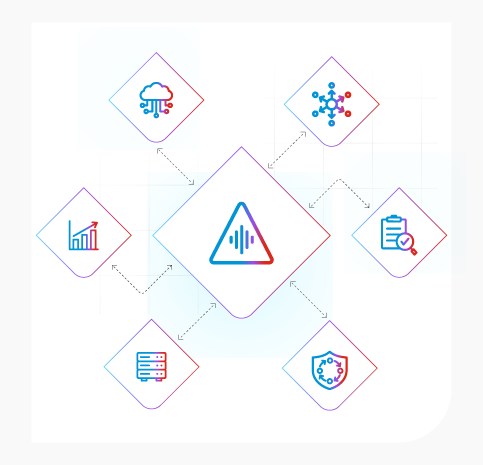
Avaya Nexus combines four foundational capabilities for critical education communications: high resiliency, hardened security and compliance, deployment flexibility, and integration readiness.
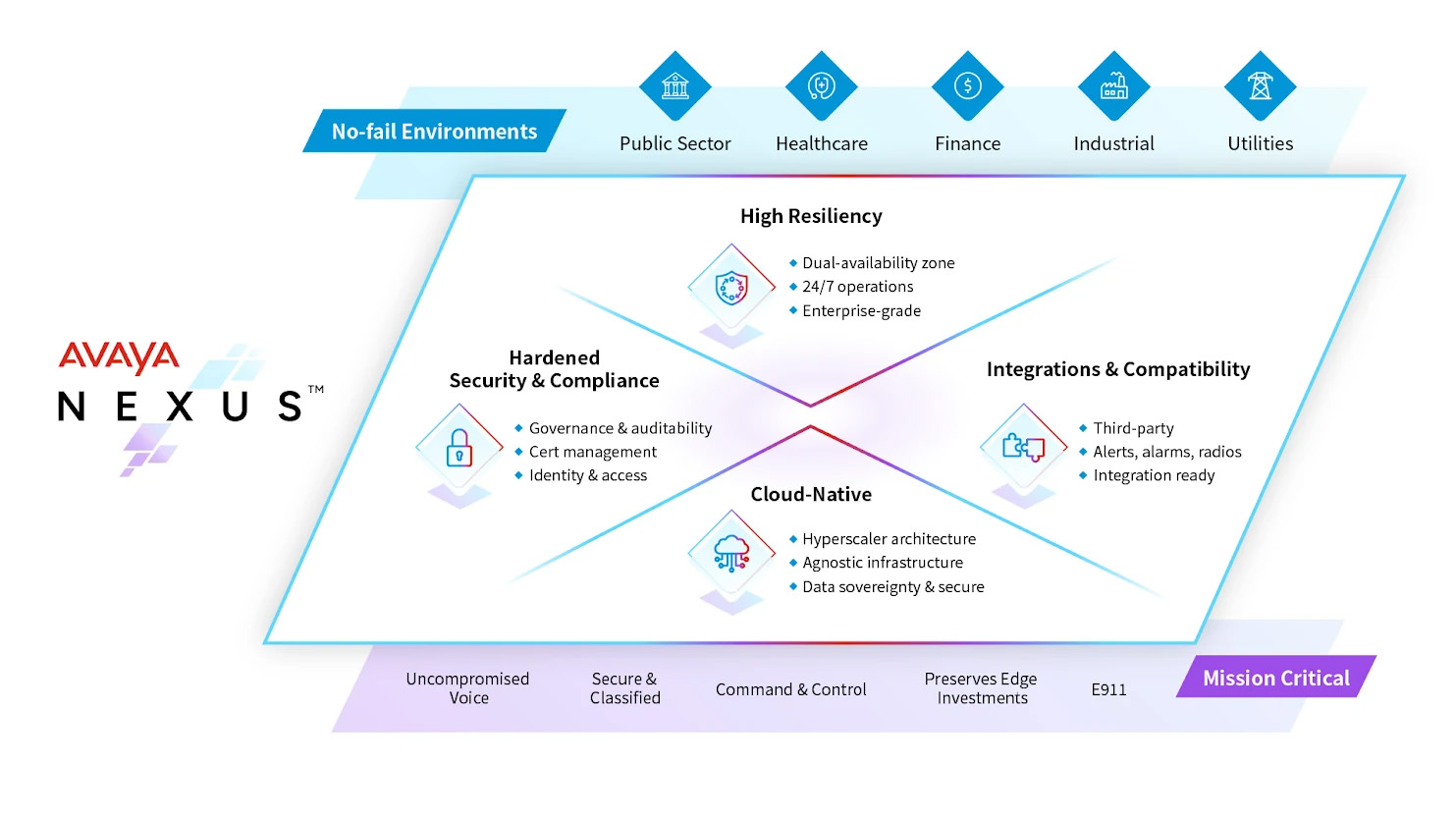
For education environments where communications cannot fail
Avaya Nexus is purpose-built for environments such as:
- College and university campuses
- K-12 school districts and large school systems
- Campus public safety and security operationsE
- mergency operations and incident response
- Student services and enrollment operations
- Health and counseling services
- Facilities and physical plant operations
- Research and specialized academic environments
- Multi-campus and geographically distributed institutions
These environments require more than bundled telephony. They require resilient infrastructure.
Critical education communications must be engineered with reliability, governance, integration, and operational control as foundational principles.
"Strengthening resilient communications capabilities is essential to ensuring continuity of critical infrastructure operations.."
U.S. Department of Energy, Resilient Communication Systems, 2025


What is aging voice infrastructure costing your institution?
Legacy voice systems pose risks like security flaws, high maintenance fees, and outages impacting campus operations and emergency response. Assess your environment and build a case for modernization using the Voice Infrastructure Impact Model.

Security, compliance, and governance for education communications
Avaya Nexus is designed to support the rigorous requirements of large, distributed, and mission-critical education environments.

Encryption
TLS-encrypted signaling and SRTP-secured media

Identity & access management
Single Sign-On (SSO), Multi-Factor Authentication (MFA), role-based access controls

Certificate management
Centralized certificate lifecycle management and governance

Audit & monitoring
Logging, monitoring, and audit-ready operational controls

Deployment security
Support for data sovereignty and controlled deployment environments

Operational resilience
Zero-downtime architecture with redundancy and failover design
For Avaya Aura education environments
Avaya Aura has long provided a resilient enterprise voice foundation for colleges, universities, school systems, and other educational institutions.
Avaya Nexus builds on that foundation with zero-downtime architecture, strengthened security, cloud-native extensibility, and flexible deployment without requiring institutions to abandon important communications investments.
“Unified communications: Not all seats are the same”
Routine meetings and emergency responses require different communication capabilities. Listen to Avaya CEO Patrick Dennis on why general collaboration must be separated from safety and continuity communications.

Frequently asked questions about Avaya Nexus for education
What is critical communications infrastructure in education?
Critical communications infrastructure is the secure, resilient communications foundation used for educational activities where availability, clarity, integration, governance, and operational control are essential.
These activities can include campus safety, emergency response, student health services, counseling, facilities operations, student support, enrollment services, administrative operations, research facilities, and communication across distributed schools or campuses.
Unlike general-purpose collaboration platforms, critical communications infrastructure is engineered for situations in which communications failure could create immediate safety, operational, student experience, or institutional consequences.
Why is voice still mission-critical for colleges and universities?
Higher education institutions increasingly use digital channels, messaging, collaboration applications, portals, and self-service tools. But voice remains critical when a situation is urgent, complex, sensitive, or requires immediate human interaction.
Examples include:
- Campus emergencies
- Student health concerns
- Counseling and crisis support
- Campus public safety
- Facilities emergencies
- Enrollment and financial aid questions
- IT support
- Residence life issues
- Research and specialized facility operations
- Parent and family inquiries
In these situations, the ability to immediately reach another person can be essential.
Why is voice still mission-critical for K-12 school systems?
Large K-12 systems may operate hundreds of schools and administrative facilities while coordinating students, teachers, administrators, transportation teams, safety personnel, facilities staff, families, and community partners.
Voice remains important for school safety, emergency response, front-office operations, family communication, transportation coordination, facilities incidents, and district administration.
Critical communications infrastructure provides the resilient foundation beneath these activities.
How is Avaya Nexus different from a traditional unified communications platform?
Traditional unified communications platforms are generally optimized around employee meetings, messaging, collaboration, and productivity.
Avaya Nexus is architected for environments that require:
- Zero-downtime reliability
- Controlled deployment
- Strong identity governance
- Encrypted communications
- Operational monitoring
- Integration with critical workflows
- Continued operation during maintenance or disruption
This allows an educational institution to use collaboration platforms where they make sense while maintaining resilient voice infrastructure for communications that cannot fail.
Is Avaya Nexus a learning management or classroom collaboration platform?
No.
Avaya Nexus is a modern, open voice infrastructure.
It is designed to provide a resilient, enterprise-controlled communications foundation that can work alongside learning management systems, collaboration applications, contact centers, notification platforms, workflow systems, safety applications, and other education technologies.
This allows institutions to select specialized applications while maintaining a resilient communications core beneath them.
How can Avaya Nexus support campus safety?
Campus safety depends on the ability to communicate reliably across people, locations, departments, and systems.
Avaya Nexus provides resilient voice infrastructure designed for continuous availability, redundancy, failover, secure communications, and integration.
This foundation can support broader campus safety strategies involving public safety operations, incident coordination, emergency notification, command operations, facilities, student services, and other critical functions.
The specific safety applications and integrations required will depend on each institution's environment.
How can Avaya Nexus support emergency communications?
During emergencies, communications demand can increase precisely when infrastructure may be under the greatest stress.
Avaya Nexus is designed around zero-downtime operations, high availability, redundancy, failover, survivability, and integration readiness.
These capabilities can help institutions maintain essential voice communications during severe weather, campus incidents, infrastructure problems, system maintenance, demand surges, and other disruptive events.
Can Avaya Nexus integrate with emergency notification systems?
Avaya Nexus is designed for API-driven interoperability and integration with operational systems, including notification and workflow platforms.
This can support an institution's broader emergency communications architecture.
Specific integrations, capabilities, and workflows should be evaluated based on the institution's existing notification systems, safety applications, infrastructure, and requirements.
Can Avaya Nexus support campus public safety operations?
Yes. Avaya Nexus can provide the resilient voice infrastructure underlying critical campus public safety communications.
Depending on the institution's architecture, this can include communications supporting dispatch, security operations, incident coordination, emergency management, facilities, administrators, and other campus stakeholders.
Specific public safety integrations and configurations should be validated for the institution's requirements.
Does Avaya Nexus support zero-downtime education operations?
Avaya Nexus is architected for zero-downtime operations through redundancy, failover, dual-availability-zone deployment models, service isolation, and continuous operation during maintenance and upgrades.
These capabilities are particularly important for institutions where a communications outage could affect campus safety, emergency response, student services, research, health services, or other critical operations.
How can Avaya Nexus help during severe weather or natural disasters?
Severe weather, hurricanes, wildfires, floods, winter storms, and other events can disrupt normal campus operations while creating increased demand for communication.
Avaya Nexus provides a resilient voice foundation designed for redundancy, failover, distributed operations, and continuous availability.
This can help educational institutions maintain critical communications as part of a broader emergency preparedness and business continuity strategy.
How does Avaya Nexus support large, distributed university environments?
Universities can resemble small cities.
A single institution may include academic buildings, residence halls, administrative facilities, athletic venues, hospitals or health centers, research laboratories, libraries, public safety operations, power and utility facilities, satellite campuses, and thousands of faculty and staff.
Avaya Nexus provides a modern communications foundation designed for large-scale, distributed environments while supporting centralized governance and operational resilience.
How does Avaya Nexus support large school districts?
Large school districts may need to connect hundreds of individual schools and operational facilities across a broad geographic area.
Avaya Nexus provides a resilient communications core that can help institutions modernize and manage critical voice across distributed locations while supporting centralized security, governance, availability, and operational control.
This can be particularly valuable for districts seeking to modernize without replacing every part of their communications environment simultaneously.
What deployment options does Avaya Nexus support?
Avaya Nexus supports flexible deployment models, including dedicated cloud and on-premises hyperscaler environments.
Supported infrastructure strategies can include environments based on Azure, Google Cloud, AWS, and Oracle Cloud Infrastructure configurations.
This flexibility can help educational institutions align communications modernization with infrastructure strategy, security requirements, data governance, operational requirements, and institutional policies.
The Health Status Dashboard also provides enhanced visibility into platform condition and service health, supporting proactive oversight.
How does Avaya Nexus support education security and privacy requirements?
Avaya Nexus provides capabilities including:
- TLS-encrypted signaling
- SRTP-secured media
- Centralized identity and access management
- Single Sign-On
- Multi-Factor Authentication
- Role-based access controls
- Centralized certificate lifecycle management
- Logging and monitoring
- Audit-ready operational controls
- Controlled deployment options
- Resilient architecture
These capabilities can support the technical and operational controls within an institution's broader cybersecurity, privacy, governance, and compliance programs.
Does Avaya Nexus make an institution FERPA compliant?
No single technology makes an educational institution FERPA compliant.
FERPA compliance depends on how an institution manages education records, access, policies, processes, technologies, workforce practices, vendors, and other controls.
Avaya Nexus provides communications security, identity governance, encryption, access control, monitoring, and deployment capabilities that can support an institution's broader security, privacy, and governance strategy.
Institutions should evaluate their specific FERPA obligations and implementation requirements independently.
Can Avaya Nexus help protect sensitive communications?
Avaya Nexus provides security capabilities such as encrypted signaling and media, centralized identity management, MFA, role-based access controls, certificate management, logging, and monitoring.
These capabilities can help organizations secure communications infrastructure and control access to critical communications services.
The protection required for specific student, employee, health, research, or institutional information depends on the applicable systems, workflows, policies, regulations, and implementation.
Can Avaya Nexus support student health and counseling services?
Avaya Nexus can provide resilient voice infrastructure for institutional functions where reliable communication is especially important, including student health, counseling, wellness, and support services.
These departments may operate specialized applications, privacy controls, contact centers, or workflows alongside the underlying voice infrastructure.
Avaya Nexus provides the communications foundation while institutions determine the appropriate applications and controls for each service.
Can Avaya Nexus support research universities?
Yes.
Research universities may operate highly specialized environments such as laboratories, medical facilities, research centers, clean rooms, high-security facilities, utility systems, and geographically distributed institutes.
These environments can have communications requirements that differ significantly from ordinary office collaboration.
Avaya Nexus provides an enterprise-controlled, resilient voice foundation that can support these complex institutional environments.
Can Avaya Nexus support university hospitals and academic medical centers?
Avaya Nexus can provide a common critical communications foundation across complex university environments that may include academic, administrative, research, and healthcare facilities.
Healthcare operations may have additional clinical, regulatory, safety, workflow, and integration requirements.
Institutions should design their communications architecture around the specific requirements of each environment while using Avaya Nexus as a resilient voice foundation where appropriate.
Can Avaya Nexus help educational institutions consolidate communications infrastructure?
Yes.
Many institutions have accumulated communications platforms, applications, endpoints, and infrastructure across campuses, schools, departments, acquisitions, expansions, and technology generations.
Avaya Nexus can provide a modernization path toward a more consistent communications architecture while allowing institutions to preserve important existing investments and modernize over time.
How does Avaya Nexus support existing Avaya Aura education customers?
Avaya Nexus provides a modernization path for Avaya Aura environments seeking cloud-native architecture, greater agility, enhanced resilience, and flexible infrastructure deployment.
It is designed as an evolution of the existing environment rather than requiring institutions to abandon their communications investments.
Avaya Aura Communication Manager, Avaya Enablement Services, and Avaya Session Border Controller remain integral to the solution while Avaya Nexus introduces a modern, containerized architectural foundation.
What is the connection between Avaya Infinity and Avaya Nexus for education?
Avaya Infinity and Avaya Nexus address two connected education priorities.
Avaya Infinity helps educational institutions orchestrate student, faculty, staff, and constituent experiences across voice, digital channels, AI, enterprise data, applications, and workflows.
Avaya Nexus provides the resilient, secure, mission-critical voice infrastructure beneath communications that must remain available.
Together, they enable institutions to pursue student experience, digital, and AI innovation while protecting the reliability of essential voice communications.
What role does AI play in Avaya Nexus?
Avaya Nexus provides the resilient voice foundation required by AI-supported capabilities such as transcription, translation, summarization, analytics, keyword detection, and automated workflows.
As educational institutions introduce more AI into student services, administrative processes, contact centers, and operational workflows, the reliability and governance of communications feeding those systems become increasingly important.
Avaya Nexus helps ensure that communications innovation rests on infrastructure designed for resilience and operational control.
Why does voice clarity matter in education?
Education conversations can involve complex, urgent, sensitive, or emotionally significant situations.
A student seeking help, a parent calling during an emergency, a faculty member reporting an incident, or a campus safety officer coordinating a response needs to be understood clearly.
Voice may also feed transcription, analytics, documentation, and AI-supported workflows.
Clear, dependable audio supports both human understanding and the accuracy of downstream systems.
Can Avaya Nexus integrate with student service and contact center environments?
Yes.
Avaya Nexus provides an open voice foundation designed to operate within a broader education technology ecosystem.
It can support communications environments that include student contact centers, enrollment operations, financial aid, advising, IT help desks, health services, and other service functions.
Specific application integration depends on the institution's systems, interfaces, implementation design, and selected Avaya or partner capabilities.
Can Avaya Nexus support hybrid and remote education operations?
Avaya Nexus provides the resilient communications foundation for institutions operating across physical campuses, satellite locations, remote employees, and distributed operations.
Institutions can combine Nexus with collaboration, contact center, mobility, and other technologies to support their broader hybrid communications strategy.
Resources for education
When communications underpin campus safety, emergency response, student support, research, or institutional continuity, they cannot be treated as optional layers.
Avaya Nexus is built for education environments where communications must simply work.
Contact us about
Avaya Nexus
Request a product preview