Rearchitecting healthcare engagement for the MCP generation
The rules of AI in healthcare are evolving rapidly. While many chase innovation, one key question emerges: Who should control your patient and caregiver experiences: your team or proprietary platforms?
Avaya Infinity is built to ensure healthcare organizations retain control over how AI is applied across clinical and operational workflows. With MCP support, care teams can deliver intelligent, compliant interactions grounded in real-world context.
What is MCP?
MCP (Model Context Protocol) is an open standard that enables AI models to securely interact with healthcare systems, such as EHRs, scheduling platforms, patient data, and clinical workflows, using structured, real-time context.
This allows AI to operate with full clinical and operational context rather than generating outputs disconnected from the systems where care decisions happen.
"This is not a 'wait-and-see' moment. Avaya believes the time to be intentional about building the definitive open orchestration engine for the modern enterprise is now."
David Funck, Chief Technology Officer, Avaya
How MCP works in healthcare
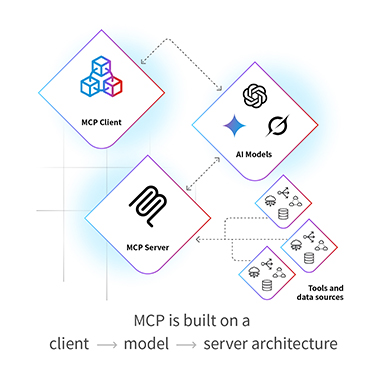
MCP operates through a three-layer architecture that connects AI directly to clinical and operational systems:
- The Client: Captures context such as patient identity, care episode, and task intent
- The Model: Processes structured context and determines the appropriate action
- The Server: Connects to systems like EHRs, labs, scheduling, and knowledge bases to execute securely
Every interaction is structured, traceable, and auditable to support compliance and accountability across healthcare workflows.
Avaya Infinity with MCP: Applying real-time context to care coordination and patient interactions
This demonstration shows how MCP enables real-time contextual insights across patient journeys, giving care teams and digital agents the full clinical picture without manual lookups.
- Unified visibility across patient data, care history, and operational systems
- AI-assisted workflows embedded into clinical and administrative processes
- Context-aware interactions based on patient history, care plans, and intent

Solving fragmentation in healthcare communication
Most healthcare AI deployments today introduce two structural challenges:
- Dependence on closed AI ecosystems that limit control and long-term flexibility
- Complex, one-off integrations across EHRs, clinical systems, and data sources
This approach fragments workflows, increases IT burden, and limits the ability to act on real-time clinical information.
MCP introduces a standardized approach to connecting AI with the systems healthcare organizations already rely on.
In typical healthcare environments, dozens of tools and data sources (EHR, scheduling, clinical knowledge bases, labs) must interact with multiple AI models to deliver meaningful care outcomes.
- Before MCP: Custom integrations multiplied complexity.
- After MCP: A single standardized interface drastically reduces integration overhead, speeds deployment, and unlocks real‑time context across care journeys.
The potential ROI for healthcare providers
With MCP, healthcare organizations can expect:
- Accelerated decision-making through real-time clinical context
- Reduced administrative burden through embedded AI workflows
- Improved patient interactions through context-aware engagement
- Lower integration and operational overhead through standardized connectivity
These gains come from AI that is not just intelligent, but situationally aware and aligned with your care priorities.
| Before MCP | After MCP | |
| Integration | Custom connectors per model/tool | One MCP interface works across models and tools |
| Deployment time | Long, expensive due to bespoke engineering | 50–70% faster, lower costs via reuse (quiq.com, Palma AI, Humanloop, aibase.com) |
| Data access | AI blind to system data, context lost | Full real-time context: CMS, CRM, EHR, ERP |
| Risk management | Manual lookup, delayed fraud detection | Instant cross-system checks reduce fraud by 30% |
The future is open
Leading AI providers are aligning around MCP because healthcare organizations require interoperability, transparency, and control. Avaya is bringing this model into care delivery and customer experience, enabling organizations to operationalize AI without introducing new silos or dependencies.
Glossary
Full glossary of terms below.
| Term | Definition | Why It Matters |
| MCP (Model Context Protocol) | An open protocol that standardizes how AI models interact with tools, APIs, and memory via structured context objects. | Enables reliable, interpretable, and scalable AI behavior across workflows and enterprise systems. |
| Context | A bundle of structured information passed to a model—such as user ID, session history, roles, time, or tool availability. | Empowers models to generate relevant, personalized, and situational responses. |
| Model | The generative AI (e.g., Claude, GPT-4, Gemini) that receives the MCP context and generates responses. | The “brain” in the loop, which uses context to make smarter, more aligned decisions. |
| Client | The application or interface (e.g., chat window, agent framework, customer portal) that gathers and sends context to the model. | The user-facing entry point that initiates requests and interactions. |
| Server | The logic layer that hosts tools, APIs, functions, and data sources the model can use via MCP. | The action-execution backend, ensuring AI outputs can trigger real-world business actions. |
| Tools | Discrete functions or APIs (e.g., “search knowledge base,” “check ticket status,” “update CRM”) exposed to the model via MCP. | Allow models to go beyond language and take actions on external systems. |
| Schemas | The structured definitions (in JSON or YAML) for how tools and context should be represented and passed to models. | Create a common language between client, server, and model, improving consistency and debugging. |
| Memory | Persistent context retained across sessions (user history, preferences, past actions) provided to the model. | Enables continuity and personalization over time — like an agent that “remembers” a customer. |
| Ephemeral Context | Short-lived, session-specific information (e.g., current task, temporary variables). | Keeps AI responses focused and efficient for the current interaction only. |
| Agent | An AI system that can take actions, invoke tools, and make decisions based on MCP context — often used in autonomous or semi-autonomous workflows. | MCP provides the backbone for enabling safe, useful, and controllable agent behavior. |
| Orchestration | Coordinating multiple steps, tools, and model outputs to achieve a higher-order business goal. | MCP simplifies orchestration by giving models access to structured context and tools in one protocol. |
| Observability | The ability to inspect what context was passed, what decisions the model made, and how tools were used. | Crucial for debugging, compliance, and enterprise trust in AI systems. |
| Interoperability | The ability for different AI models and platforms to work with a shared structure of tools and context. | MCP enables plug-and-play AI across different vendors and architectures. |
Ready to deliver connected, compassionate care?
Contact us